

Last updated: October 9, 2026
Gemini 4 Argon is Google's new frontier model and Claude Opus 5.5 is Anthropic's flagship for agentic coding and knowledge work; both list at $4 per million input tokens and $20 per million output tokens, but Argon is on a $2/$10 launch promo and, as of October 9, 2026, only a small group of cyber defenders can use it.
TL;DR
Pick Claude Opus 5.5 today. You can't buy Argon yet; only Google's Fairwind cyber defenders have it.
Opus wins coding, long context and knowledge work on neutral tests, 58 to 53 on the Artificial Analysis Intelligence Index.
Argon wins business-app automation and makes things up less, once you can get it.
Cost: same $4/$20 list price, but Argon writes about half as much, so it's $3.98 per task against $5.98 for Opus at max, and half that on the promo.
Anthropic shipped Opus 5.5 on September 22 (FOMA covered it). Google announced Argon on September 30 and handed it to cyber defenders first, guardrails off (FOMA's issue).
Gemini 4 Argon release date: who can use it today?
Announced September 30, 2026. Here's who has it as of October 9:
Confirmed: Google says Argon is "rolling out to a set of trusted cyber defenders through our Fairwind Program," and that those defenders and Google's own teams get it without cyber guardrails. Next in line: "paid API customers and Google AI Ultra subscribers." No date.
Not in the Gemini API: Argon isn't on the models page, the pricing page or the changelog.1
Not in the Gemini app: the release notes have no Argon entry. No app tier has it, Ultra included.
Not on Vertex (now Gemini Enterprise Agent Platform): the Agent Platform docs list only older Gemini models. No regions, no quotas.2 Google Cloud's October 8 keynote post name-drops "Argon for frontier reasoning" in its lineup and then says nothing about how you'd get it.
Unconfirmed: a reported Vertex billing-catalogue entry called "Gemini 4 Argon Cyber Permissive" (write-up), and X posts insisting Ultra and API access drop on October 9. Google hasn't confirmed either. Treat them as weather forecasts.
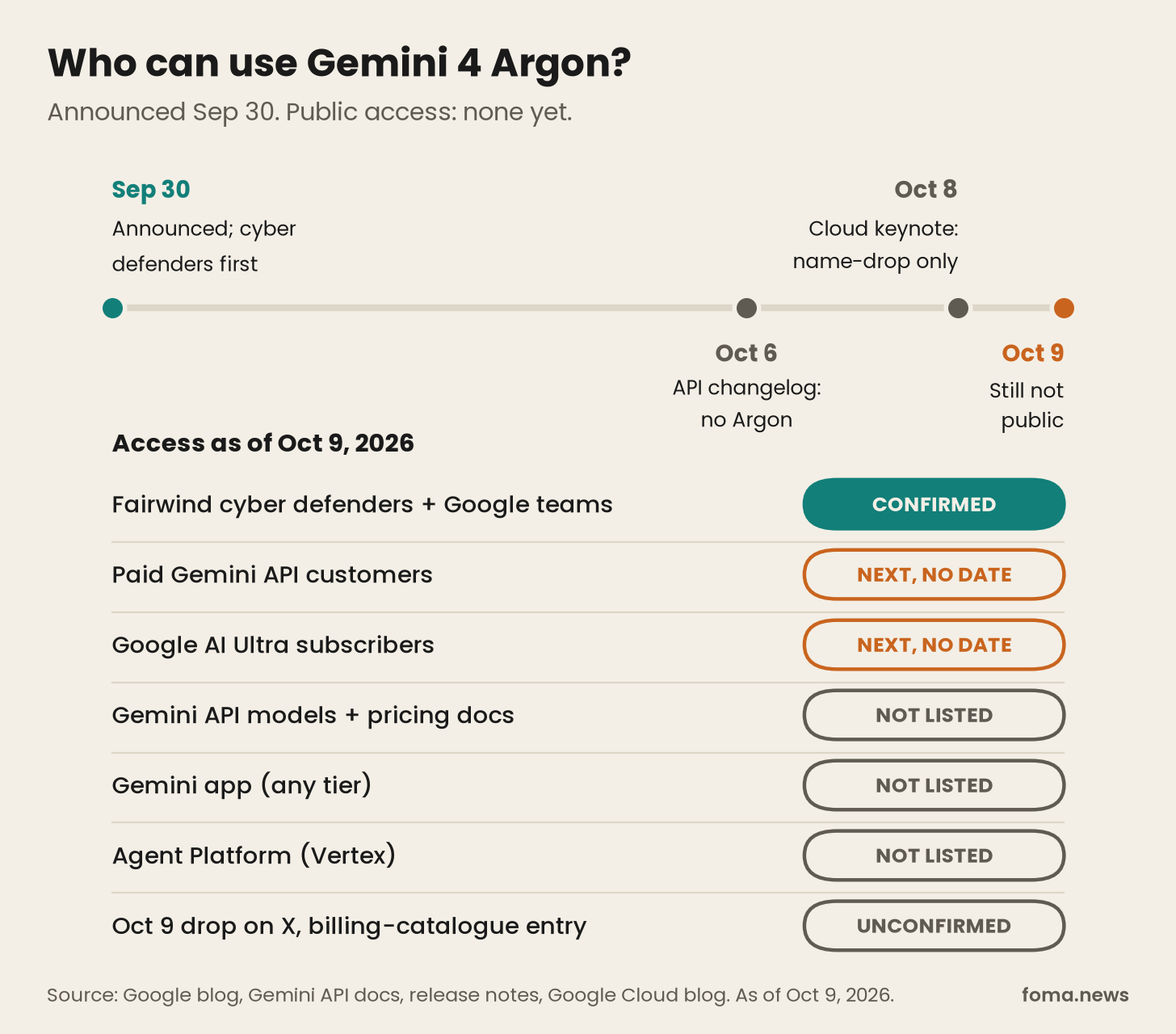
Artificial Analysis lands in the same place: rolling out to selected users, "not publicly available."
Is there a Gemini 4 Argon API?
Not a public one. No model ID, no docs, no rate limits. What exists is a price for a thing you can't buy: $2 input and $10 output per million tokens during an introductory period, then $4 and $20 (Google's announced price).3 Argon's output limit is 1M tokens, up from 64K, per Google. ONE MILLION output tokens. That's a novel per reply.
Opus 5.5 is boring by comparison, which is a compliment. It's claude-opus-5-5 on the Claude API, Amazon Bedrock, Google Cloud and Microsoft Foundry, with a 1M-token context window and 128K max output (models overview).
How to use Gemini 4 Argon right now
If you're not a Fairwind defender, you can't. The useful prep: get a paid Gemini API key (Google says paid API customers go first) and build against a model that exists, so swapping the ID later is a one-line change. Don't guess model IDs off screenshots.
Gemini 4 Argon vs Opus 5.5: benchmarks
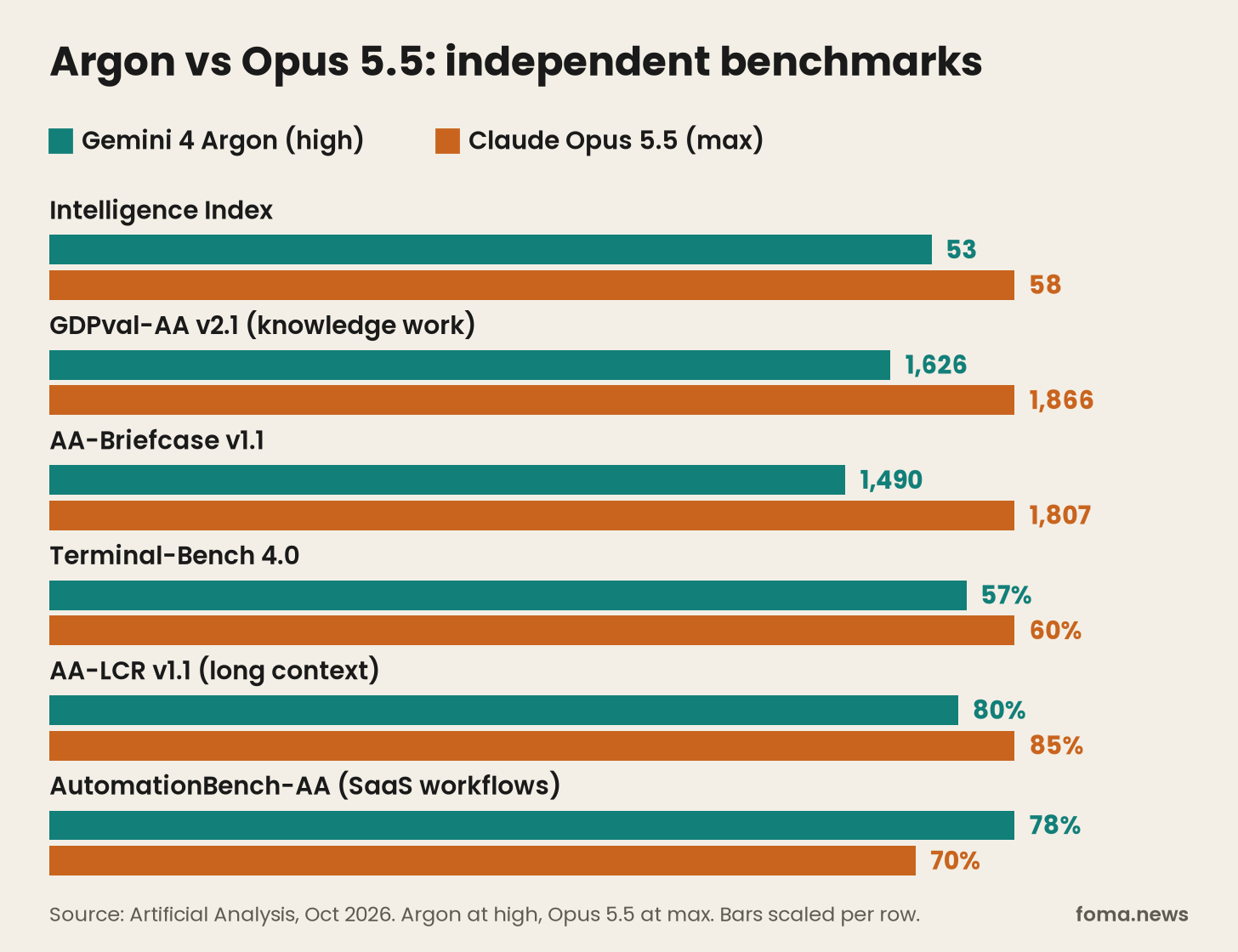
Neutral referee first. Artificial Analysis ran Argon at high (its highest setting) and Opus 5.5 at max. Opus leads its Intelligence Index 58 to 53 and also wins knowledge work, Terminal-Bench 4.0 and long context. Argon wins SaaS workflows on AutomationBench-AA, 78% to 70%.4
Artificial Analysis also measured Argon's hallucination rate at 15%, the lowest of any model scoring 45+ on its index. A frontier model that admits it doesn't know things. Wild.
The crowd disagrees with the referee. Argon is #1 on Text Arena and first on the Vals Index, with Opus 5.5 behind it on both.5
Both labs publish their own numbers too. Each lab grades its own homework on its own setup, so don't line these up against each other.6
Gemini 4 Argon vs Opus 5.5 pricing
Once the promo ends, the price lists are twins: $4 input, $20 output, and $0.20 cache reads.7 On the promo, Argon is half off everything.
The per-task cost formula
Cost = (fresh input × input price + cache reads × cache price + output × output price) ÷ 1,000,000.
Assumptions: no cache writes, standard tier, list prices as of October 9, 2026, made-up but realistic token counts.
Agent coding session, 2,000,000 cache reads, 200,000 fresh input, 100,000 output. Opus: $3.20. Argon: $1.60 on the promo, $3.20 at standard.8
Long document, 600,000 tokens in, 10,000 out. Opus: $2.60. Argon: $1.30 on the promo, $2.60 at standard, unless Google bolts on a long-context surcharge.
One giant answer, 50,000 in, 1,000,000 out. Argon on the promo: $10.10. Opus can't do it in one response; its cap is 128K.
Identical prices mean the bill comes down to how much each model talks. Artificial Analysis counts about half as many output tokens per task for Argon as for Opus at max.9 Opus at max is the coworker who answers "yes" with a memo. Measured cost per task: Argon $1.99 on the promo, $3.98 at standard, Opus $5.98 at max (Artificial Analysis). So at standard pricing, Opus at xhigh beats Argon on score AND cost.10
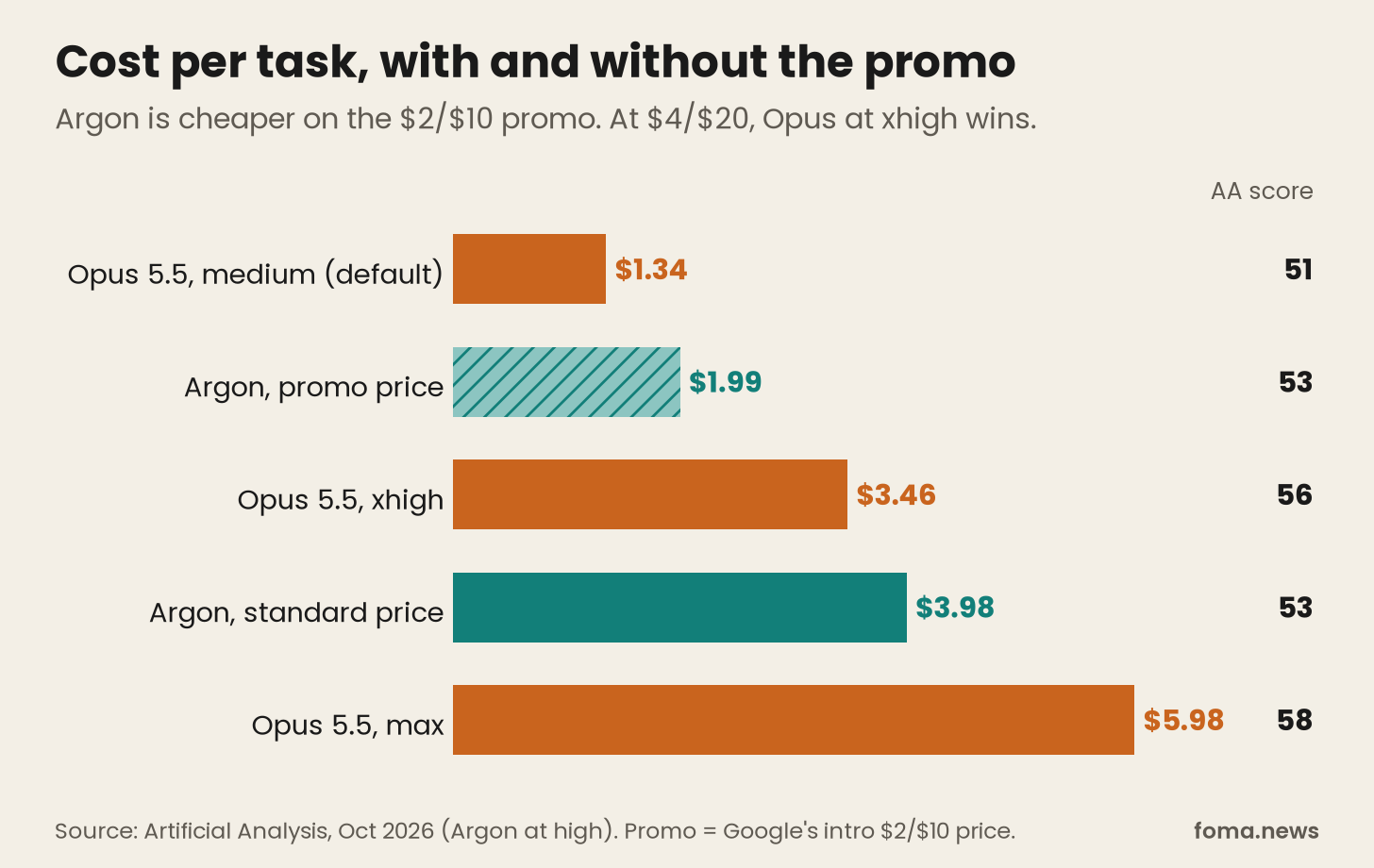
Opus has five effort levels, low to max, default medium. Turning the dial is most of your cost control.
Which one should you use?
Today, for anything: Opus 5.5. Argon isn't available, which is a pretty decisive benchmark.
Coding agents: Opus 5.5. It leads Terminal-Bench 4.0 and runs on every major cloud. Argon's DeepSWE score is Google's own.
Business-app automation: Argon, once you get access. It leads AutomationBench-AA.
Long context: Opus for reading (the higher AA-LCR score, flat price to 1M). Argon for writing, with a 1M output limit vs 128K.
Multimodal: Probably Argon. Artificial Analysis lists text, image, video and speech input; Opus takes text and images. Argon's long-video score is vendor-reported.
Knowledge work: Opus on GDPval-AA. If confident nonsense is your biggest risk, Argon's 15% hallucination rate is the stat to test.
Budget: Argon on the promo. After it ends, Opus at xhigh.
Gemini 4 Argon vs Astra
GPT-6 Astra costs $10/$50 and ties Argon at 53 on the Artificial Analysis index, at $3.26 per task. GPT-6.1 Sol costs $2/$10 and scores 52.11 The full OpenAI-vs-Anthropic fight is in GPT-6 Astra vs Claude Fable 5.1.
What else should you consider?
Claude Sonnet 5.5: $2/$10, and it beat Opus 5.5 on Terminal-Bench 4.0 at launch (FOMA's issue). Vals has it ahead of its own big brother.12
Going cheap: Claude Haiku 5.5 vs GPT-6 Luna covers the $0.10 tier.
So, Argon or Opus 5.5?
You came here to choose between Gemini 4 Argon and Claude Opus 5.5, and today that's an easy call: Opus 5.5 is the one you can actually use, and it wins coding, long context and knowledge work. Once Google opens Argon up, it's the pick for business-app automation, for fewer made-up answers, and for cheap runs while the promo lasts. After the promo, Opus at xhigh is the better deal. Until then, build on Opus and keep the model swap a one-line change.
Notes
As of October 9: the models page was last updated October 6 UTC, the pricing page October 7 UTC, and the changelog's newest entry is October 6 (changelog).
The Agent Platform docs list Gemini 3.1 Pro and Gemini 3 Flash.
Cached input is 95% off during the promo. Google hasn't said when the intro period ends; Artificial Analysis says the discount runs "for at least one month."
Artificial Analysis, Argon at high vs Opus 5.5 at max with Anthropic's safeguard fallback on, Opus first (comparison): Intelligence Index 58 vs 53; GDPval-AA v2.1 (knowledge work) 1866 vs 1626; AA-Briefcase v1.1 1807 vs 1490; Terminal-Bench 4.0 60% vs 57%; AA-LCR v1.1 (long context) 85% vs 80%; AutomationBench-AA (SaaS workflows) 70% vs 78%.
Text Arena, October 8 snapshot: Argon #1 at 1525, marked preliminary on 4,892 votes; Opus 5.5 high #2 at 1507. Vals Index, updated October 7: Argon first at 68.90%, Opus 5.5 third at 66.97%.
Argon's cache price is its 95% discount; Opus 5.5's cache reads are $0.20. Opus 5.5 charges that rate across its full 1M context. Google hasn't published an Argon long-context tier or a cache-write price.
The math, with the rates in note 7. Session: Opus $0.40 + $0.80 + $2.00 = $3.20; Argon promo $0.20 + $0.40 + $1.00 = $1.60. Long document: Opus $2.40 + $0.20 = $2.60. Giant answer: Argon promo $0.10 + $10.00 = $10.10.
62k output tokens per task for Argon and 119k for Opus at max (Artificial Analysis).
Opus at xhigh scores 56 for $3.46, and at medium, the default, 51 for $1.34. Vals saw the same story: $15.68 per test for Argon, $32.14 for Opus (Vals Index).
Argon's promo cost per task is 2.7x Sol's (Artificial Analysis). On Vals, Astra scores 63.13% and GPT-6.1 Sol 61.15%.
Sonnet 5.5 scores 67.04% on the Vals Index, against 66.97% for Opus 5.5.