

Last updated: October 8, 2026
Claude Haiku 5.5 is Anthropic's cheapest, fastest model and GPT-6 Luna is OpenAI's cheapest GPT-6 model; both cost $0.10 per million input tokens and $0.50 per million output tokens on the API, but Haiku thinks out loud for longer and gets 5x more expensive past 100,000 tokens.
TL;DR
Pick GPT-6 Luna for bulk work (classification, extraction, routing) and for long prompts. It's cheaper per task at every effort level.
Pick Claude Haiku 5.5 for anything that touches a terminal, a browser or a codebase. It wins Terminal-Bench 4.0 by 33% to 13%.
Same sticker, different bill: Haiku writes about 3x more output, so Artificial Analysis measures $0.21 per task for Haiku and $0.07 for Luna at max effort.
Watch the 100K cliff: past 100,000 tokens of prompt, Haiku's price goes 5x.
Anthropic shipped Haiku 5.5 on October 7 and priced it to the cent on top of Luna, which OpenAI launched in September next to GPT-6 Sol (FOMA covered that week). Same sticker. Not the same bill.
What is Claude Haiku 5.5 good for?
The boring, high-volume stuff that used to be too expensive to bother with: summaries, compaction, database queries, classification, live support, browser use, and grunt work as a sub-agent while Opus 5.5 or Sonnet 5.5 does the thinking on a coding job. It's the first Haiku with effort settings (default medium), and it gets a 1M-token context window.1
Anthropic is also refreshingly honest about the ceiling: Sonnet 5.5 and Opus 5.5 "remain better choices" for complex agentic coding. Haiku is the intern you give narrow, well-scoped tickets, not the one you hand the migration.
What is GPT-6 Luna?
OpenAI calls Luna its "most efficient model for focused, high-volume tasks," which is lab for "the cheap one." It also has a context window of about a million tokens, and effort levels from none to max.2 Starting October 8, it's rolling out as the ChatGPT model for Free and Go users, per OpenAI's rollout post (FOMA's issue), so a lot of people's first taste of GPT-6 is this one. OpenAI's Decisions API, the thing that classifies and routes, runs on Luna too (FOMA covered it).
Claude Haiku 5.5 vs GPT-6 Luna: benchmarks
Neutral referee first. Artificial Analysis ran both at max effort. Haiku scores higher on its Intelligence Index (43 to 38), is far better in a terminal (33% to 13% on Terminal-Bench 4.0), wins knowledge work and is about twice as fast. Luna wins SaaS workflows on AutomationBench-AA. Long context is a tie.3
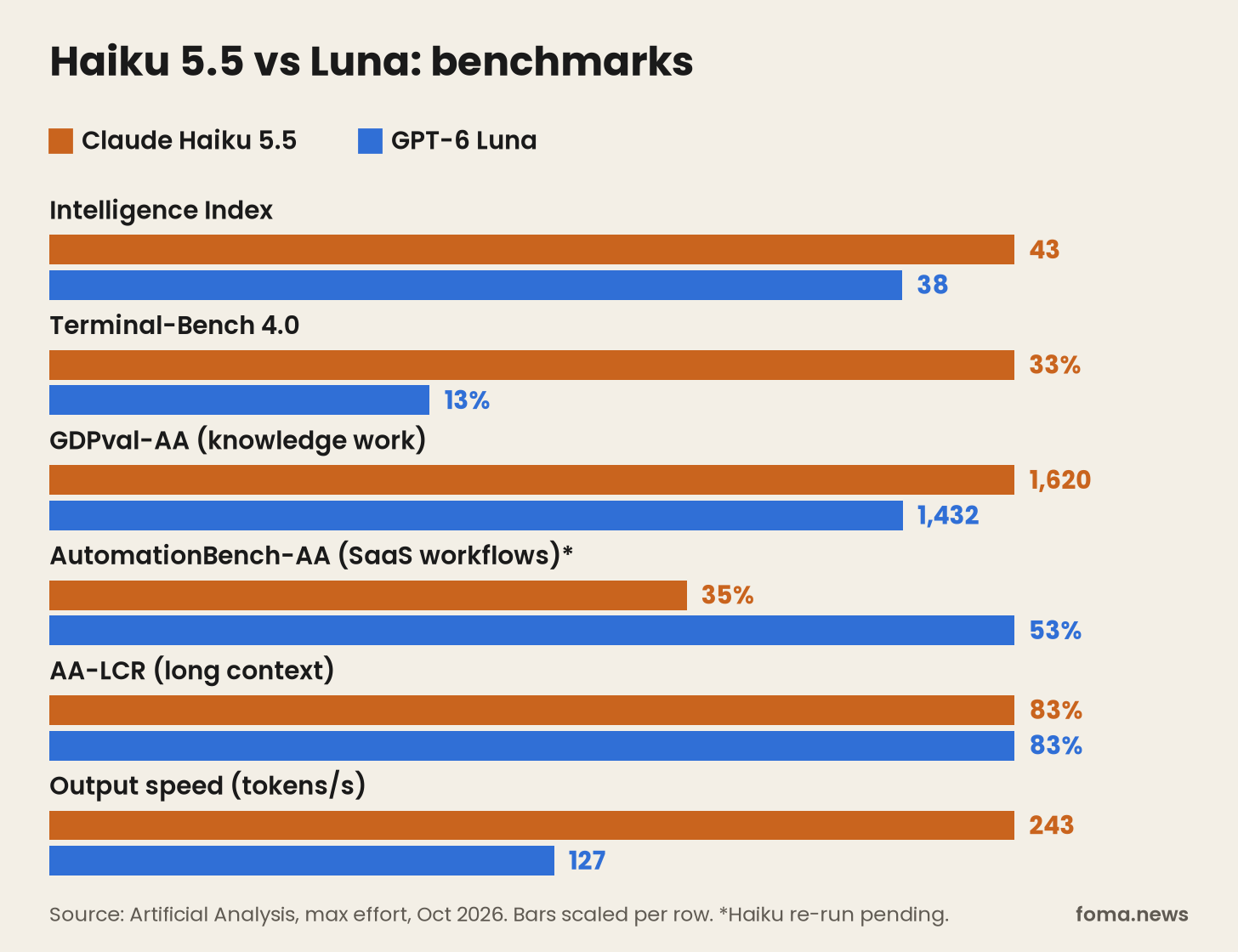
Asterisk on AutomationBench: Artificial Analysis says a pre-release safety issue made Haiku over-refuse, and it plans to re-run the test once Anthropic's fix lands, expecting the score to rise. So Luna's one clean win might be partly Haiku saying no to its homework. Same write-up, better news for Haiku: it makes things up about half as often.4
Anthropic's own table shows even bigger Haiku leads on computer use and coding. Vendor numbers, vendor salt.5
Haiku 5.5 vs Luna 6 pricing: same sticker, different bill
Up to 100,000 tokens, Anthropic's price list matches OpenAI's line for line: $0.10 input and $0.50 output per million tokens, with the same cache and batch discounts. That's 90% below Haiku 4.5.6 Then the price lists stop being twins:
Claude Haiku 5.5 over 100,000 tokens: 5x on every rate, priced per request by prompt length.
GPT-6 Luna over 272,000 input tokens: 2x input and 1.5x output.7
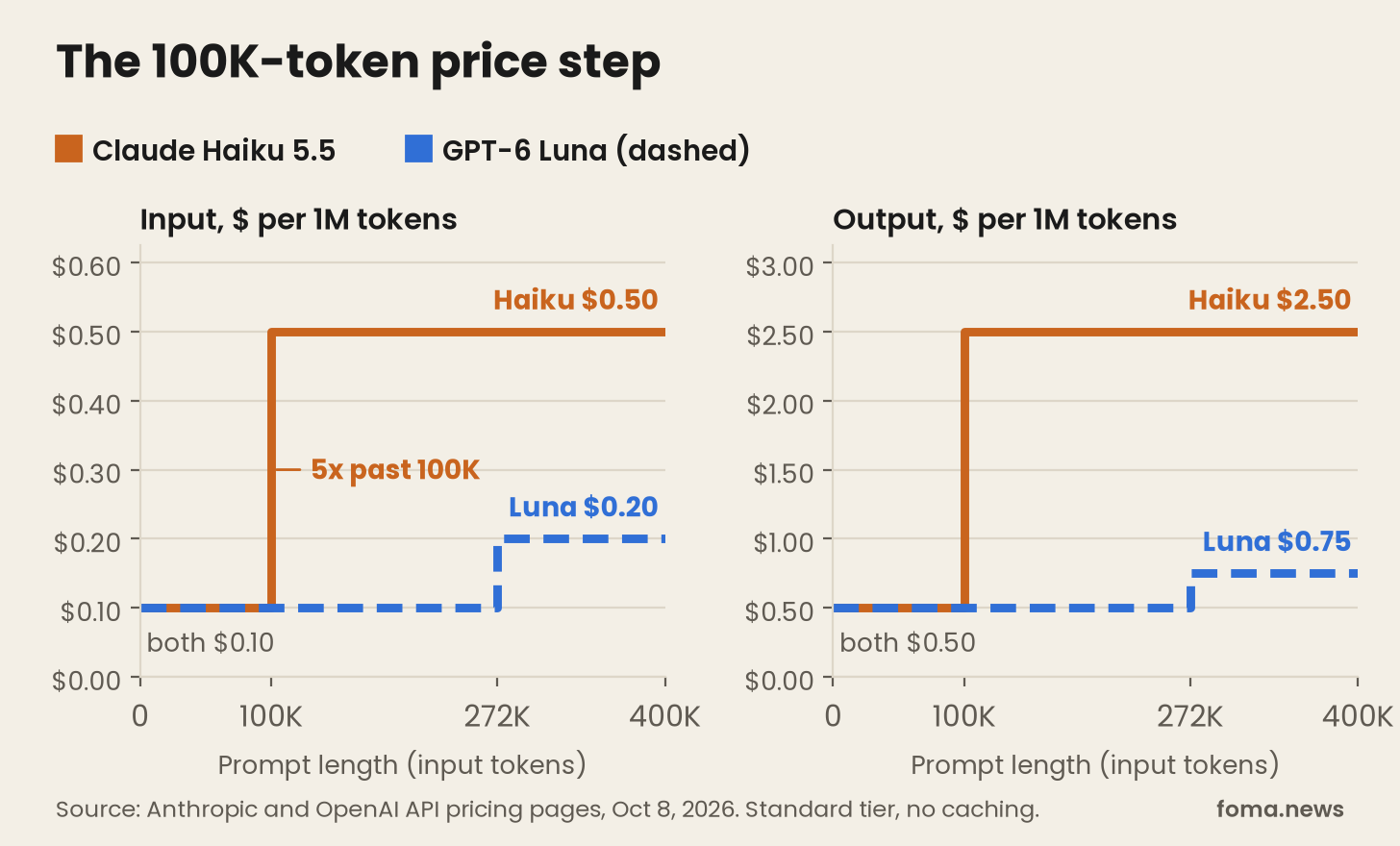
Anthropic says prompts up to 100,000 tokens were around 90% of requests to the previous Haiku, so most calls never hit the cliff. The sneakier cost is tokens. Artificial Analysis measured Haiku at max effort writing roughly 3x Luna's output per task, and reasoning tokens bill as output.8 Same price per token, more tokens. Here's the math.
The per-task cost formula
Cost per call = (input tokens × input price + cached tokens × cache price + output tokens × output price) ÷ 1,000,000.
Assumptions below: no caching, standard tier, list prices as of October 8, 2026, and made-up but typical token counts. Swap in your own logs; your logs know things I don't.
Extraction, 3,000 tokens in, 300 out. $450 per million documents on either model. If Haiku writes 3x the output, it's $750. The gap is 1.67x, not 3x, because input is two-thirds of the bill.9
Long document, 150,000 tokens in, 2,000 out. Luna: $0.016. Haiku crosses 100K: $0.080. FIVE TIMES the price before Haiku writes a single extra token.
Huge document, 300,000 tokens in, 2,000 out. Luna crosses 272K: $0.0615. Haiku: $0.155. About 2.5x, because Luna finally has a surcharge of its own.10
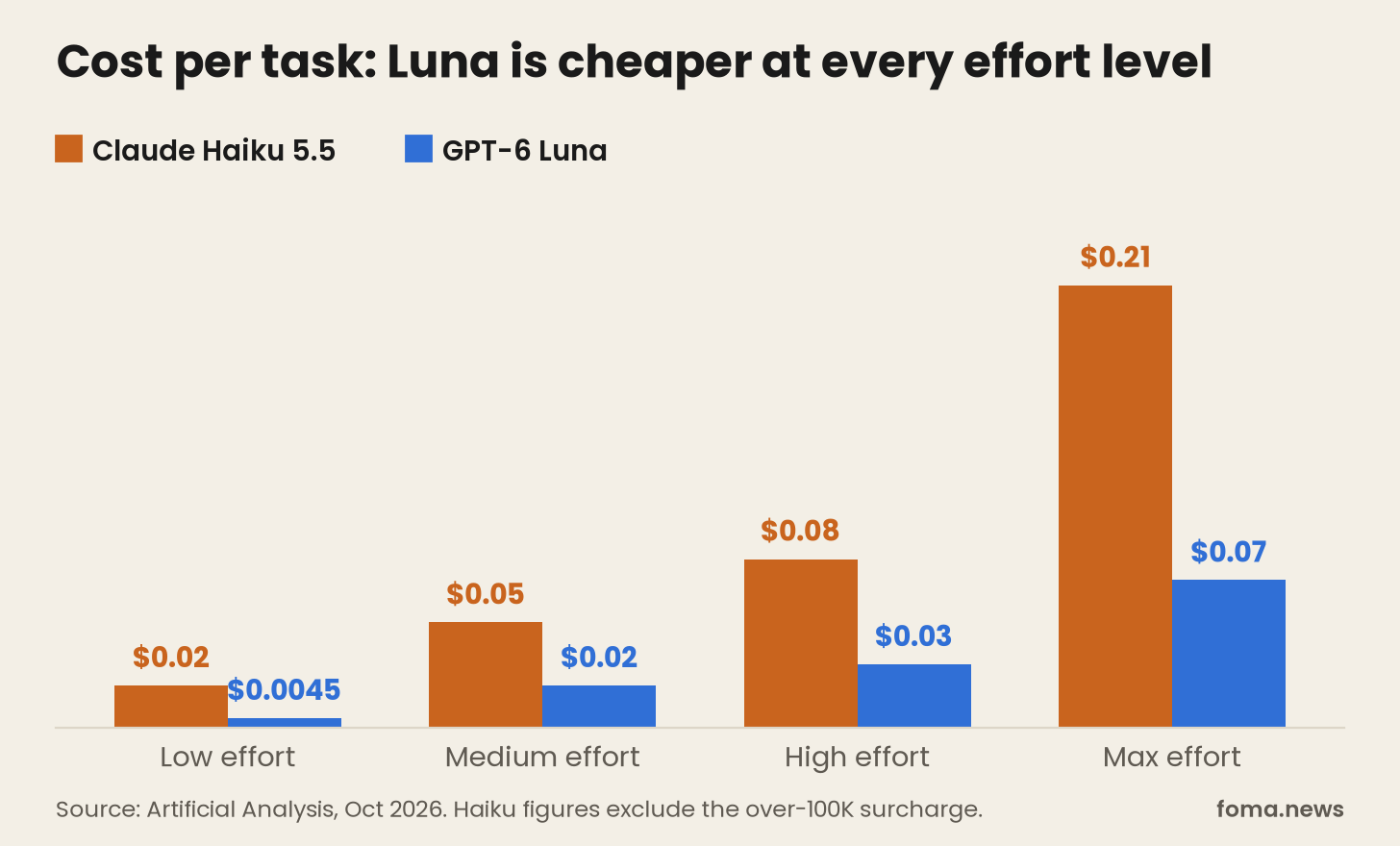
Now the measured version. Artificial Analysis puts cost per task at $0.21 for Haiku and $0.07 for Luna at max effort, and Luna wins every effort label (release comparison).11 Line them up by score instead and it's basically a tie on price, with Haiku answering much sooner.12 One more hedge: those Haiku figures don't include the over-100K surcharge yet, so they run low.
Which one should you use?
High-volume classification and extraction: Luna. Cheaper per task at every effort level, a much faster first token at low effort, and the Decisions API is sitting right there.13 Switch to Haiku when a confident wrong answer costs you more than the tokens do.
Agents and tool use: Split. For SaaS and API workflows, Luna for now on AutomationBench, until the re-run. For terminal, browser and computer use, Haiku, and it isn't close (33% versus 13% on Terminal-Bench 4.0).
Long context: Luna. Same long-context score, and it stays at base price until 272K while Haiku goes 5x at 100K.
Coding sub-agents: Haiku. It's what Anthropic built it for, and the Terminal-Bench gap is wide. Keep each sub-agent's prompt under 100K and the sticker price holds. Set effort on purpose: max costs far more tokens than xhigh for a small gain.14
Knowledge work and document analysis: Haiku, on GDPval-AA.
Haiku 5.5 vs Gemini 3.8 Flash
Gemini 3.8 Flash is the third option, and it is not priced like the other two: $0.75 input and $3.75 output per million on a launch rate, which is 7.5x Luna's sticker, and the price doubles in January (Google's pricing).15 Artificial Analysis scores it 41, between Luna and Haiku, with the best factual recall of the three.16 Pick it if you already live on Google's stack or need recall. At 7.5x the token price for a score between the other two, it's hard to justify on cost alone.
What else is cheap?
Claude Sonnet 5.5: $2 / $10, and on Haiku's launch day Anthropic halved its cache reads to $0.10, which it says makes Sonnet around 20% cheaper on most agentic work. That's the real step up when the coding gets hard. FOMA's Sonnet 5.5 issue has the rest.
Going bigger: FOMA's GPT-6 Astra vs Claude Fable 5.1 comparison covers the expensive end of both lineups.
So, Haiku 5.5 or Luna?
You opened this to find out which cheap model to use, and the price tag won't decide it because it's identical. Use Luna for bulk classification, extraction and long documents: it costs less per task and has no cliff at 100K tokens. Use Haiku for coding sub-agents, terminals and browsers: it's the stronger agent and earns its extra tokens there. If you run both kinds of work, use both and route each job to the right one.
Notes
Haiku 5.5 has a 1M-token context window and 128K max output, per Anthropic's models overview. Anthropic says it runs around 75% cheaper than Haiku 4.5 on average.
Luna has a 1,050,000-token context window and 128,000 max output tokens (model page). OpenAI cut its price 50% versus GPT-5.6 Luna at launch.
Artificial Analysis, both at max effort, Haiku first (comparison): Intelligence Index 43 vs 38; Terminal-Bench 4.0 33% vs 13%; GDPval-AA (knowledge work) 1620 vs 1432; AutomationBench-AA (SaaS workflows) 35% vs 53%; AA-LCR (long context) 83% each; output speed 243 vs 127 tokens/s.
Hallucination rate: 40% for Haiku against 77% for Luna (Artificial Analysis).
From Anthropic's announcement: OSWorld 2.1 (computer use, offline subset) 72.4% for Haiku versus 48.9% for Luna; FrontierCode 1.1 46.4% versus 42.4%.
Shared rates up to 100K tokens, per million: $0.10 input, $0.01 cache reads, $0.125 cache writes, $0.50 output. Batch halves both. Haiku 4.5 was $1 / $5. Sources: Anthropic pricing, OpenAI pricing.
Haiku 5.5 over 100,000 tokens: $0.50 input, $0.05 cache reads, $0.625 cache writes, $2.50 output (Anthropic pricing). Luna over 272,000 input tokens: 2x input and cache rates and 1.5x output, so $0.20 input and $0.75 output (OpenAI pricing).
About 162k output tokens per task for Haiku and 50k for Luna at max effort (Artificial Analysis).
The math, with the rates in note 6. Luna: 3,000 × $0.10 + 300 × $0.50 = $0.00045 per document. Haiku with the same tokens: also $450 per million. Haiku with 900 output tokens: $0.00075.
The math, with the rates in notes 6 and 7. Long document: Luna $0.015 + $0.001 = $0.016; Haiku $0.075 + $0.005 = $0.080. Huge document: Luna $0.06 + $0.0015 = $0.0615; Haiku $0.15 + $0.005 = $0.155.
Cost per task, Haiku vs Luna: $0.21 versus $0.07 at max, $0.08 versus $0.03 at high, $0.05 versus $0.02 at medium, and $0.02 versus $0.0045 at low (Artificial Analysis release comparison).
Haiku at high scores 38 for $0.08; Luna at max scores 38 for $0.07. Haiku gets its first token out in 26.15 seconds versus 108.60 (Artificial Analysis release comparison).
First token at low effort: 3.23 seconds for Luna versus 11.99 for Haiku (Artificial Analysis release comparison).
Max adds 2 points over xhigh for about 1.8x the tokens.
Gemini 3.8 Flash: $0.75 input and $3.75 output per million tokens through December 31, 2026, then $1.50 and $7.50 from January 1, 2027 (Google's pricing). It has a 1M-token context window and 64k max output (Google's docs).
Artificial Analysis on Gemini 3.8 Flash: Intelligence Index 41, 20% on Terminal-Bench 4.0, and 55% accuracy on factual recall with a 55% hallucination rate (Artificial Analysis).