

Last updated: October 11, 2026
A decision model API is an endpoint that reads your input and answers fixed questions about it (yes or no, one option from your list, or a level on your scale) with probabilities instead of generated text, and bills you for input tokens only.
All 14 models we ranked: TypeSafe Jev, OpenAI Decisions API, Cloudflare Clef, Microsoft-Decision-1, Liquid d1, Kev, Perplexity Decider, Inception Mercury Decide, PostHog Jeeves 9B, AWS Strands Decider 2B, Laya, Respan Span-01, Upstage Solar Decide and Together Tev1.
TL;DR
Start with TypeSafe Jev. It led or tied both large independent tests, costs $0.042 per million input tokens, and carries most OpenRouter traffic.
Pick the OpenAI Decisions API for images or OpenAI's compliance terms. $0.10 per million, in beta.
For long inputs and the lowest bill, Perplexity Decider reads up to 262K tokens per request at $0.02 per million.
To own the weights, use Cloudflare Clef (open and hosted) or Kev (self-host).
How we ranked them
Each model gets an evidence label. Independent tests means 500 or more cases run by someone with no model in the race: Arize's October 7 test or Benchmark Heaven's JevBench. Vendor claims only means the maker's numbers. Price and usage only (no accuracy numbers) fits none.
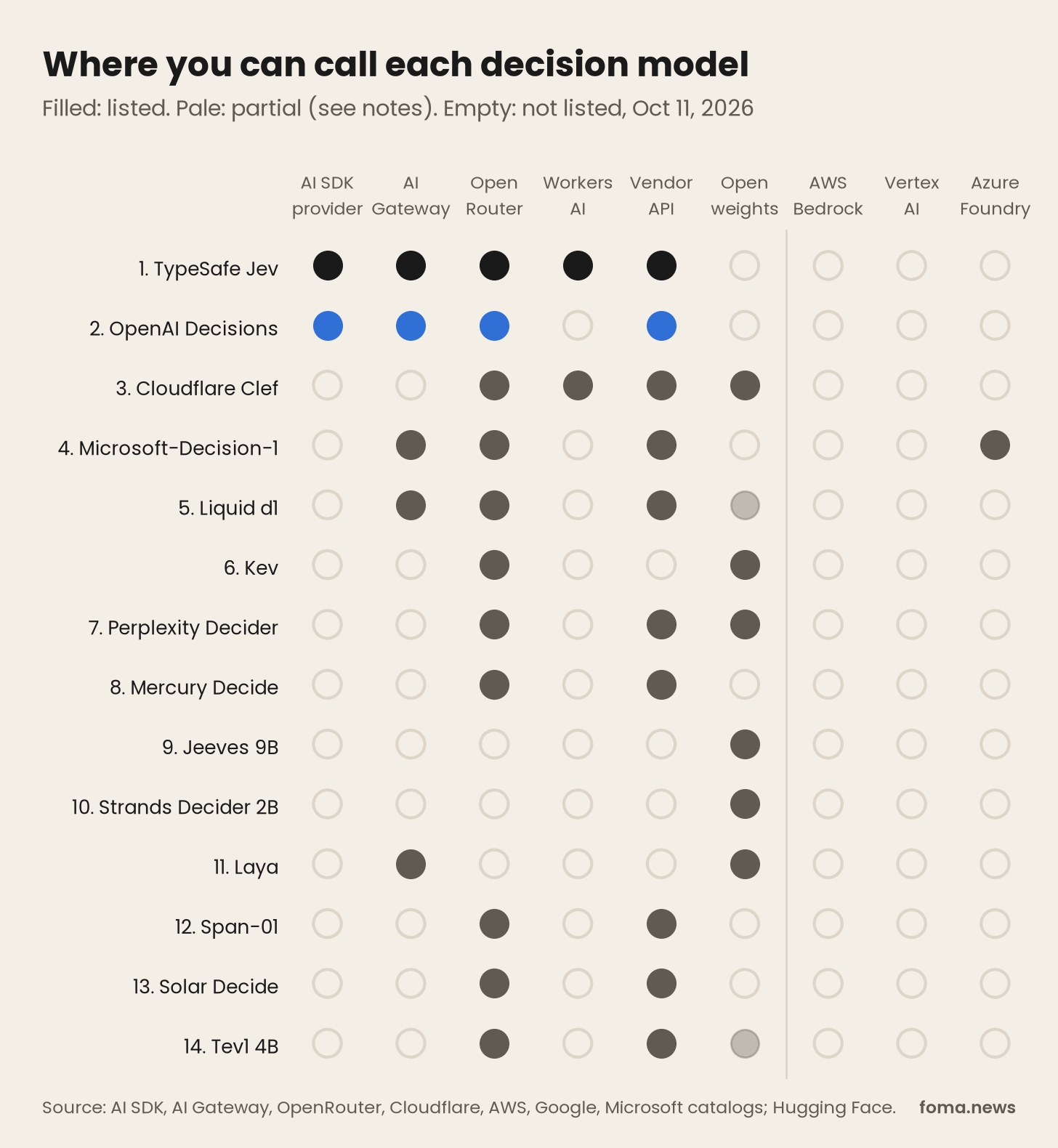
Independent tests rank first. Within a label, we order by OpenRouter requests this week, then by Arize accuracy. Anthropic and Google have no native decision model.1 "Where to use it" lists every place found among nine platforms checked October 9 to 11. Only Microsoft-Decision-1 is on a big cloud (Microsoft Foundry); none is on Bedrock or Vertex AI.2 Specs give p50 latency and who measured it ("vendor" marks maker figures), then input limit, inputs, caps and weights.3
The 14 best decision model APIs, ranked
1. TypeSafe Jev
The first decision model, jev-1.13.0 (TypeSafe docs).
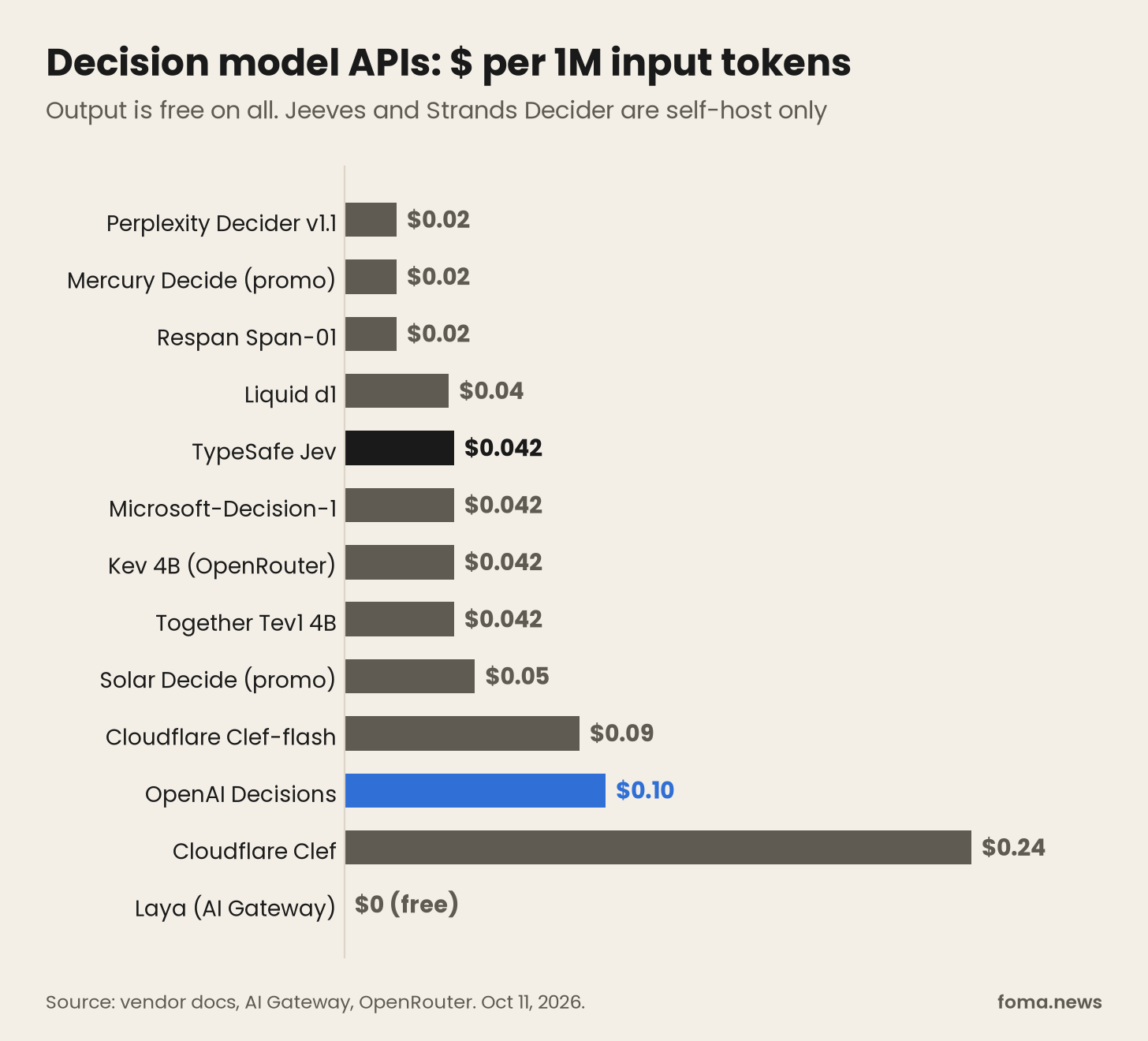
Price: $0.042 per million input tokens.
Where to use it: TypeSafe's API, the AI SDK, AI Gateway, OpenRouter and Cloudflare Workers AI.4
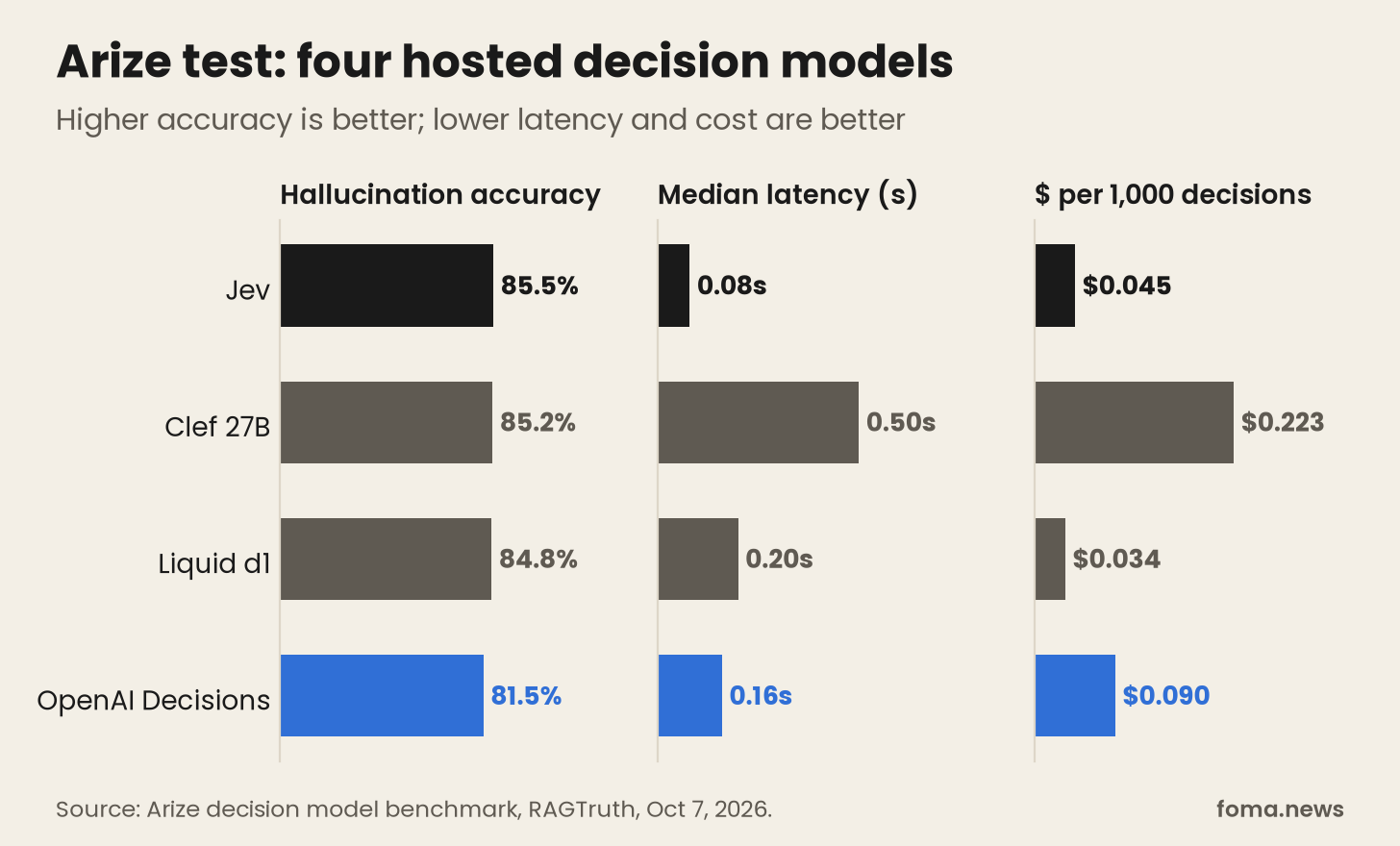
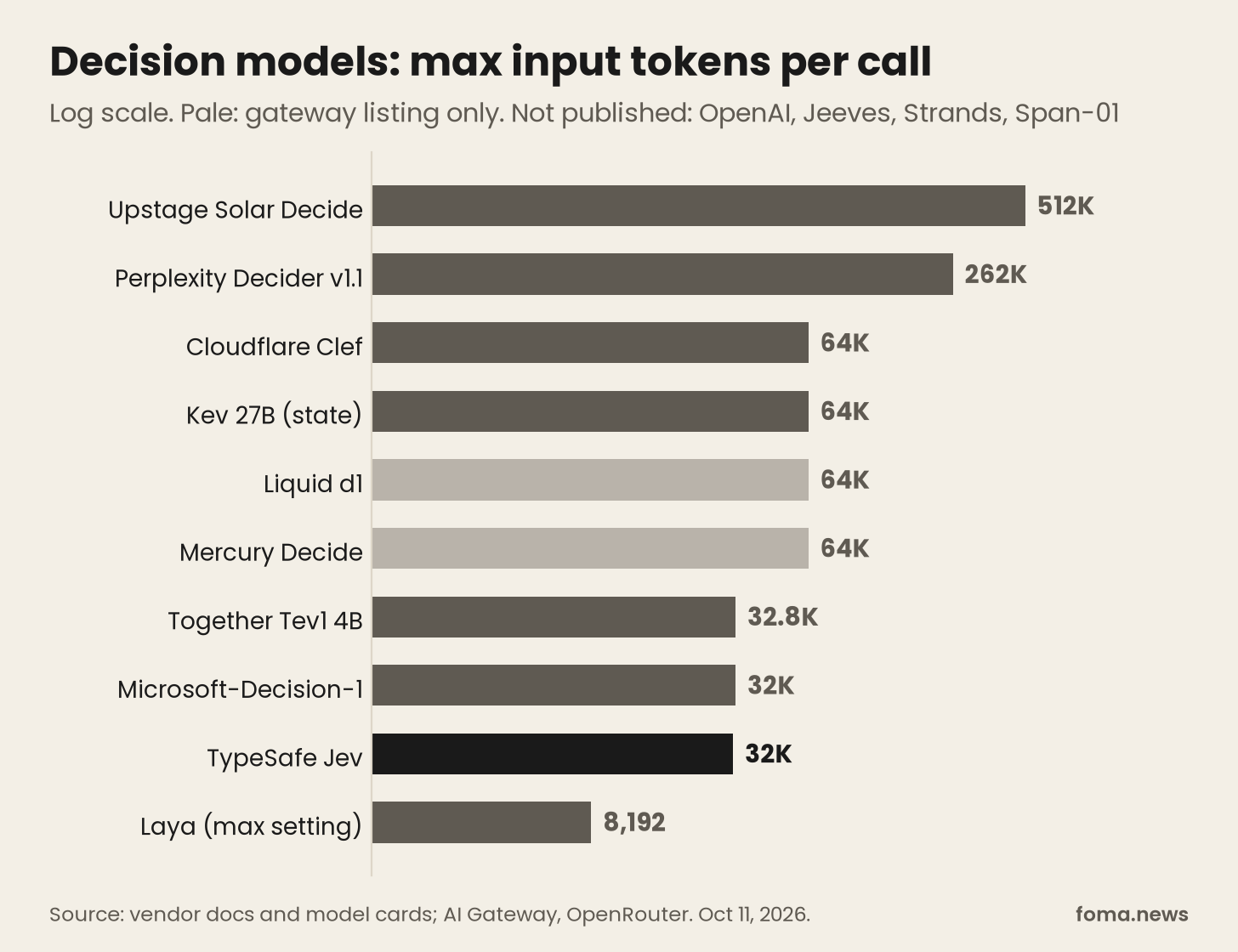
Specs: 0.08 s p50 (Arize), 526 ms p99 (agent.nexus); 32K input; text; question cap not published; closed.5
Evidence: Independent tests. Top or tied in every Arize round, best calibrated, stable when reworded.6
Best for: Text routers, tool gates and eval judges. See FOMA's Jev how-to.
2. OpenAI Decisions API
POST /v1/decisions on gpt-6-luna, public beta since October 6 (OpenAI guide).
Price: $0.10 per million, about 2x Jev per call.7
Where to use it: OpenAI's API, the AI SDK, AI Gateway and OpenRouter.8
Specs: 0.16 s p50 (Arize), 1,469 ms p99 (agent.nexus); input limit not published; text, images; question cap not published; closed.9
Evidence: Independent tests. 81.5% at Arize, behind the top three.10
Best for: Image checks and OpenAI shops. See FOMA's Decisions API vs Jev.
3. Cloudflare Clef and Clef-flash
Open decision models since October 1 (Cloudflare, FOMA).
Price: $0.24 per million for Clef, $0.09 for Clef-flash on Workers AI (pricing).11
Where to use it: Workers AI, OpenRouter and Hugging Face.12
Specs: 0.50 s p50 (Arize); vendor: 209 ms, Clef-flash 39 ms; 64K; text, JSON, images, video; 1–64 questions; open.13
Evidence: Independent tests. Matched Jev's accuracy at Arize, but cost $0.223 per 1,000 decisions against $0.045.14
Best for: Open weights with a hosted fallback.
4. Microsoft-Decision-1
Microsoft's hosted Qwen3.5-9B post-train, from October 9 (Microsoft).
Price: $0.042 per million input tokens; output is free.
Where to use it: Microsoft Foundry, AI Gateway and OpenRouter.15
Specs: 0.46 s p50 (Benchmark Heaven); 32K input; text, JSON; question cap not published; closed.16
Evidence: Independent tests, one so far: sixth of hosted APIs on JevBench, behind Jev on accuracy and calibration.17
Best for: Azure shops.
5. Liquid d1
Liquid AI's hosted d1 (Liquid).
Price: $0.04 per million on AI Gateway and OpenRouter.
Where to use it: Liquid's API, AI Gateway and OpenRouter. Smaller open siblings only.18
Specs: 0.20 s p50 (Arize); vendor: 200–300 ms; 64K per gateways; text, plus images on Liquid's API; question cap not published; closed.19
Evidence: Independent tests. 84.8% at Arize at the lowest cloud cost, but the worst wording failure.20
Best for: Cheap text decisions with controlled wording.
6. Kev
Jared Palmer's open family, 0.8B to 27B (Jared Palmer).
Price: Free to self-host; Kev 4B is $0.042 on OpenRouter.
Where to use it: Hugging Face, or Kev 4B on OpenRouter.21
Specs: 1.03 s p50 for Kev 9B on a laptop (Arize); 64K state (Kev 27B); text; question cap not published; open.22
Evidence: Independent tests. Kev 9B tied Jev on Arize's routing final but fell to a coin flip when reworded.23
Best for: Self-hosting and fine-tuning.
7. Perplexity Decider
pplx-decider-v1.1-27b replaced v1 on October 6 at half the price (Perplexity docs).
Price: $0.02 per million (changelog).
Where to use it: Perplexity's API, OpenRouter and Hugging Face.24
Specs: latency not published; 262K; text, JSON, images; 1–128 questions; open.25
Evidence: Independent tests. Top JevBench capability score, 82.8 against 77.1 for Jev, but untested at full length.26
Best for: Whole transcripts and contracts.
8. Inception Mercury Decide
Hosted, on Jev's request format, since September 30 (Inception).
Price: $0.02 per million (50% off $0.04), with a free tier on OpenRouter.27
Where to use it: Inception's API and OpenRouter.
Specs: 0.33 s p50 (Benchmark Heaven); 64K per OpenRouter; text, JSON; question cap not published; closed.
Evidence: Independent tests. Third of 26 hosted APIs on JevBench, with weaker calibration than Jev.28
Best for: Free experiments.
9. PostHog Jeeves 9B
An open 9B model that reasons before it decides (Hugging Face).
Price: Free to self-host.
Where to use it: Hugging Face only.
Specs: 16.8 s p50 on a laptop (Arize); vendor: 3.3 s on an H100; context not published; text; question cap not published; open.29
Evidence: Independent tests. 80.3% at Arize, but flipped when reworded.30
Best for: Offline judging.
10. AWS Strands Decider 2B
AWS Strands Labs' open 2B model from October 1 (Strands).
Price: Free to self-host.
Where to use it: Hugging Face and GitHub; an AWS guide self-hosts it on SageMaker AI.31
Specs: 0.34 s p50 on a laptop (Arize); vendor: about 115 ms; input limit not published; text, experimental images; question cap not published; open.32
Evidence: Independent tests. 69.0% at Arize, and flipped when reworded.33
Best for: Laptop experiments and Strands agents.
11. Laya
Convai Innovations' 322M encoder (Arize).
Price: $0 on AI Gateway (Vercel).
Where to use it: AI Gateway and Hugging Face.34
Specs: 0.04 s p50 on a laptop (Arize); vendor: about 35 ms; 8,192 tokens; text; question cap not published; open.35
Evidence: Independent tests. Last at Arize, 59.8%.
Best for: Simple, high-volume checks on a CPU.
12. Respan Span-01
Scores agent behaviors you define in plain language (Respan).
Price: $0.02 per million; Span-01 Lite is free.
Where to use it: Respan's API and OpenRouter.36
Specs: latency and context not published; text traces; no cap on behaviors; closed.37
Evidence: Vendor claims only. Respan reports F1 of 84.3 against 71.5 for Jev on its own benchmark.38
Best for: Guardrails on agent traces.
13. Upstage Solar Decide
A hosted beta on Solar Mini 4, strong in Korean (Upstage).
Price: $0.10 per million, $0.05 on OpenRouter during a promotion.
Where to use it: Upstage's API and OpenRouter.39
Specs: latency not published; 512K; text; 2–26 options per question; closed.
Evidence: Vendor claims only. Upstage reports 98.4% on about 400 questions; a small outside test disagrees.40
Best for: Korean text and very long documents.
14. Together Tev1 4B
An experimental Qwen3.5-4B fine-tune (Together).
Price: $0.042 per million on OpenRouter.
Where to use it: Together's API, OpenRouter and Hugging Face.41
Specs: latency not published; 32.8K window; text; one question, 2–24 options; open weights, licence pending.
Evidence: Vendor claims only. Together reports 88.0% on its own development set.42
Best for: Copying the recipe to train your own.
How do the decision model APIs compare?
Which decision model should you use?
Agent routing and tool gates on text: Jev.
Screenshots, scans and photos: OpenAI Decisions, or d1, Clef or Perplexity.
Eval judges: Jev (best calibrated) or Clef.
Long documents: Perplexity (262K tokens), or Solar Decide (512K, vendor numbers only).
Data on your own servers: Clef, Kev or Jeeves.
Already on Azure: Microsoft-Decision-1.
Lowest bill: Perplexity, Mercury Decide or Liquid d1.
Whichever you pick, set thresholds on your own labelled cases.
So, which decision model API should you use?
For most builders, the answer is Jev: cheap, best tested and easiest to reach. Switch to OpenAI's Decisions API for images or compliance terms. Use Perplexity for long inputs or the lowest bill. Choose Clef or Kev for weights.
Notes
The AI SDK's Decisions page lists Anthropic (claude-haiku-4-5-20251001) and Google (gemini-3.5-flash-lite) adapters alongside TypeSafe and OpenAI; they prompt a chat model, so their probabilities are estimates or missing. Background: Jev launched on September 15 (FOMA), open clones followed (FOMA), then OpenAI (FOMA); Arize counts about 10 makers (Arize).
Catalogs checked on October 9: Bedrock's model cards (AWS), Vertex AI Model Garden (Google) and Microsoft Foundry's model list, which added Microsoft-Decision-1 on October 9 (Microsoft). The other six: each vendor's API, the AI SDK, AI Gateway, OpenRouter, Cloudflare Workers AI and Hugging Face. Open weights can still run on your own instances in any cloud. Usage is OpenRouter's decision ranking with data through October 8.
Arize called hosted models over the network and ran open models on a MacBook Pro (Apple M4 Max, 36 GB), so its laptop latencies aren't comparable with hosted ones (Arize). agent.nexus timed both decision APIs from its own desk (agent.nexus). Benchmark Heaven times hosted APIs at their public endpoints (Benchmark Heaven). OpenRouter showed no latency or throughput figures for these listings on October 9 (OpenRouter API). Context is each listing's input limit per request.
IDs: typeSafeAi.decisionModel('jev-latest') in the AI SDK, typesafe-ai/jev on AI Gateway (served by TypeSafe and DigitalOcean), typesafe/jev-1.13 on OpenRouter, and typesafe/jev on Workers AI, a third-party listing at $0.042 per million input tokens with a 32,000-token context and zero data retention (Cloudflare).
TypeSafe caps the state plus the longest question at 32K tokens, the practical input limit, and the whole request, state plus every question, at 64K. It lists rate limits of 100K tokens and 80 requests per second, text only, with no published question cap (TypeSafe docs). AI Gateway and OpenRouter's Jev guide both give 32K (AI Gateway, OpenRouter). Latency: 0.08 s median at Arize (Arize); 269 ms p50, 388 ms p95 and 526 ms p99 at agent.nexus (agent.nexus); 0.24 s median at Benchmark Heaven (Benchmark Heaven).
Arize scores for Jev 1.13: 85.5% balanced accuracy on RAGTruth hallucination detection, 91.1% on 13 Phoenix evaluator suites, 49 of 52 routing decisions, calibration error 0.023, 0.08 seconds median latency, $0.045 per 1,000 decisions. On the reworded question its ROC AUC stayed at 0.93 (Arize). OpenRouter: 987M requests this week, against 6.75M for the runner-up (OpenRouter). Benchmark Heaven's JevBench gives it a capability score of 77.1.
Arize: $0.090 per 1,000 decisions against $0.045 for Jev (Arize). agent.nexus: $0.22 per 1,000 calls against $0.11 (agent.nexus).
IDs: openai.decisionModel('gpt-6-luna') in the AI SDK and openai/gpt-6-luna-decisions on AI Gateway and OpenRouter. Three clouds carry gpt-6-luna without the Decisions endpoint: Workers AI as text generation (Cloudflare), Bedrock as a model card with no decisions mention (AWS), and Azure for the Responses API (Microsoft). A Microsoft moderator said on October 7 there is no confirmed date for the Decisions API on Foundry (Microsoft Q&A). Zero data retention, HIPAA and US or EU data residency are available for eligible customers.
agent.nexus measured the Decisions API at 268 ms p50, 584 ms p95 and 1,469 ms p99 (agent.nexus). OpenAI publishes no input-token limit for /v1/decisions: its API reference caps each text part at 10,485,760 characters and a request at 128 images, with no token figure (API reference). The 1,050,000 that AI Gateway and OpenRouter list is gpt-6-luna's total context window, which OpenAI's model page shares with up to 128,000 output tokens (OpenAI), so it is not a Decisions input limit (AI Gateway, OpenRouter). The guide says long-context input pricing applies. OpenAI's guide publishes no per-request question cap and claims answers about 10x faster than its Responses API (OpenAI guide).
Arize: 0.16 seconds median against Jev's 0.08, 90.0% on evaluators, 48 of 52 routing (Arize). OpenRouter: 6.75M requests this week.
Because the weights are open, other hosts undercut Cloudflare. On OpenRouter, PrimeIntellect serves Clef at $0.042 and Clef-flash at $0.021 per million, with a 16K context against Cloudflare's 64K (OpenRouter).
IDs: @cf/cloudflare/clef and @cf/cloudflare/clef-flash on Workers AI, cloudflare/clef and cloudflare/clef-flash on OpenRouter (served by Cloudflare and PrimeIntellect), and weights at Hugging Face.
Arize: 0.50 s median for Clef 27B (Arize). Cloudflare's own test across 43 evals: 209.3 ms median and 238.6 ms p95 for Clef, 38.8 ms and 122.4 ms for Clef-flash, against 524.1 ms and 536.0 ms for Jev (Cloudflare blog). Workers AI takes 1 to 64 questions and up to 4 images per request, reads the state as text, JSON, images or video, lists a 65,536-token context window and truncates long text state to fit; it publishes no separate per-question limit (Cloudflare).
Arize scores for Clef 27B: 85.2% hallucination, 91.5% evaluators, 50 of 52 routing, 0.50 seconds median against 0.08 for Jev (Arize). OpenRouter: 5.15M requests for Clef-flash and 3.73M for Clef this week. Vendor claims: Cloudflare reports a self-run Decision Index score of 61.21 against 57.91 for Jev (Cloudflare leaderboard, Cloudflare blog).
Microsoft-Decision-1 is sold directly by Azure in Microsoft Foundry, generally available, at /providers/microsoft/v1/systemone (Foundry catalog, Microsoft Learn). microsoft/microsoft-decision-1 is on AI Gateway and OpenRouter at $0.042, both served by Azure; OpenRouter counted 4.16M requests in the week to October 10. Not on Bedrock, Vertex AI, Workers AI or Hugging Face on October 11.
The Foundry catalog gives inputs of up to 32K tokens (a 32,768-token window), text in, JSON scores out, and no images, audio or video (Foundry catalog). Microsoft's how-to takes a text or JSON state and several yes/no, choice or score questions per request, with no published question or option cap (Microsoft Learn). The base model is open; Decision-1's weights are not published. Benchmark Heaven measured a 459 ms median over 124 requests on October 10 (Benchmark Heaven). Vendor claim: 2.5x faster than the runner-up, H2O-Lightning-4B v1.1, and about 35x faster than GPT-6 Sol at p50 (Microsoft).
Benchmark Heaven ran 1,500 decisions (1,200 sealed, 300 public) against Foundry on October 10: composite 69.1 against 71.5 for Jev, capability 70.8 against 77.1, calibration 84.4 against 90.6, $0.019 per 1,000 decisions, with 21 context-limit failures scored as misses (Benchmark Heaven). Vendor claims: the highest accuracy across Microsoft's 36 benchmarks of nearly 150,000 questions, and decisions that flip on 1.3% of reworded requests (Microsoft).
Arize: 0.20 s median (Arize). Liquid's claim: 200 to 300 ms per text decision (Liquid). Liquid's d1 API docs refer to a per-question input token limit but give no number, only a 4.5 MB request body (Liquid docs). The 65,536 is AI Gateway's and OpenRouter's listing (AI Gateway, OpenRouter). Liquid gives 32K for the open d1-3B (Liquid docs). Liquid says one request can ask several questions but publishes no cap.
Liquid counts a 1024×1024 image as 1,536 input tokens and bills each question as its own prompt. Vendor claim: 19x to 200x cheaper than GPT-6.1 Sol and Claude Opus 5.5 on its six demo apps (Liquid). Arize measured $0.034 per 1,000 decisions, and ROC AUC fell from 0.92 to 0.17 on the reworded question; it says d1 briefly topped Hugging Face's Decision Index, 58.9 to 57.9 for Jev (Arize). OpenRouter: 3.96M requests this week.
Checkpoints up to Kev-27B on Hugging Face. OpenRouter serves jaredpalmer/kev-4b through SiliconFlow. There is no hosted API from Kev's maker.
Arize ran Kev 9B on its laptop: 1.03 s median on RAGTruth, 0.19 s on the Phoenix suites (Arize). The Kev 27B card serves states of up to 65,536 tokens plus at least 8,192 per question, validated to 65,536, and doesn't load the vision tower (Hugging Face). OpenRouter serves Kev 4B with 8,192 (OpenRouter). Vendor claim: Kev 4B answers five questions about a short text in 721 ms on a 32 GB M5 Mac (Jared Palmer).
Arize scores for Kev 9B: 48 of 52 routing against 49 for Jev, 76.8% hallucination, 88.7% evaluators, ROC AUC 0.85 falling to 0.54 on the reworded question (Arize). OpenRouter: 2.66M requests for Kev 4B this week.
ID perplexity/pplx-decider-v1.1-27b on OpenRouter, which lists the 262K context. Weights under Apache 2.0 at Hugging Face, whose config sets 262,144 positions. OpenRouter: 2.1M requests for v1.1 and 1.95M for v1 this week.
Perplexity's limits: under 262,144 input tokens counting the state, images and every question, 1 to 128 questions per request, 1 to 255 options per question, up to 10 score levels and 10 requests per second per organization (Perplexity docs). That is 8x the 32K Jev allows for the state plus the longest question. Only Solar Decide publishes more, a 512K window (Upstage); OpenAI publishes no Decisions input limit. Perplexity publishes no API latency; Benchmark Heaven's run of the open weights on its own hardware measured 0.12 s median, which says little about the API (Benchmark Heaven).
Benchmark Heaven's capability score is the mean of its intelligence and calibration axes on 1,500 JevBench decisions; the Perplexity row was run on the open weights, and its tasks are short (Benchmark Heaven). Vendor claims: at launch Perplexity said v1 scored 85.71% across its benchmarks (Perplexity on X), and it says v1.1 scores highest on Hugging Face's Decision Index 0.3 (Perplexity).
Inception lists $0.04 cut to $0.02 per million input tokens, output free, at POST /v1/decisions with model mercury-decide (Inception). OpenRouter serves inception/mercury-decide at $0.02 and a free inception/mercury-decide:free variant, both with a 65,536-token context (OpenRouter); Inception's model table leaves the context column blank for Mercury Decide, so 64K is OpenRouter's figure. The free variant served 1.67M requests this week.
Benchmark Heaven JevBench v1.6.1: composite 72.4 against 71.5 for Jev, on equal weights for intelligence, calibration, speed and cost; intelligence 65.9 against 63.6, calibration 81.3 against 90.6, median 0.33 seconds. Its cost axis is an estimate because Mercury was free when tested (Benchmark Heaven). In one small independent test of 90 Korean chat reports, the free model scored 66.7% against 83.3% for Jev (ReportJevBench). Vendor claim: Inception calls it the most intelligent decision model on OpenRouter on JevBench v1.4, without printing a score, at up to 14 decisions per second.
Arize ran Jeeves on its laptop: 16.8 s median on RAGTruth, 4.3 s on the Phoenix suites (Arize). PostHog's own figures on one H100: 3.3 s median and 17.1 s p90 with full thinking, about 0.3 s with thinking off at lower accuracy (Hugging Face). PostHog states no context limit. Weights Apache 2.0, code MIT.
Arize scores for Jeeves 9B: 80.3% hallucination, 87.1% evaluators, 48 of 52 routing, calibration error 0.043, 16.8 seconds median; ROC AUC 0.85 falling to 0.25 on the reworded question (Arize). Vendor claim: 0.935 on JevBench's public tiers against 0.866 for Jev, with thinking (PostHog). Not on OpenRouter, AI Gateway or any cloud catalog.
Weights at Hugging Face (v21, Apache 2.0), built on Qwen3.5-2B (TechCrunch). An AWS solutions architect's guide deploys it on a SageMaker AI endpoint you run yourself (AWS Builder Center); it is not in Bedrock's model cards. The card reports its evals at a 4,096-token window but publishes no input limit; image input is experimental.
Arize scores for Strands Decider 2B: 69.0% hallucination, 76.7% evaluators, 45 of 52 routing, calibration error 0.065; ROC AUC 0.75 falling to 0.26 on the reworded question (Arize). Vendor claim: 176 of 231 on JevBench's public set (Hugging Face).
ID convaiinnovations/laya on AI Gateway, served by Boundless. Weights, plus a multilingual variant, at Hugging Face. Arize tested Laya multilingual: 59.8% hallucination, 57.3% evaluators, 40 of 52 routing, ROC AUC 0.64 falling to 0.36 on the reworded question (Arize). No hosted API from Convai found.
Arize: 0.04 s median for Laya multilingual on its laptop (Arize). AI Gateway lists 8,192 tokens (AI Gateway). Convai's card: laya-multilingual reads up to 8,192 tokens when set to, but ships at 1,024 (English Laya at 512) with part of the window kept for the options, and results vary beyond about 4,000 tokens; all questions run in one forward pass in about 35 ms on a GPU, and 103 to 332 questions per second batched on a T4 (Hugging Face). Arize lists the weights as Apache 2.0.
Respan's endpoint is POST /api/v1/scores with span-01-free or span-01-pro (Respan docs). OpenRouter lists respan/span-01 at $0.02 per million (OpenRouter) and respan/span-01-lite free (OpenRouter); Lite served 5.03M requests this week and Span-01 1.13M. Its request shape differs from Jev's. No open weights found.
Respan's docs set no per-request cap on behaviors, and definitions count as input tokens (Respan docs). OpenRouter lists no context length for Span-01 (OpenRouter), and Respan publishes no latency.
Span-01 returns present, absent or not observable for each behavior. Respan's chart: Span-01 84.3 F1, GPT-6 Luna 81.5, Jev 71.5. Respan also ran 11 decision models with Span-01 as the judge and put Jev first at 0.932 accuracy and Tev1 4B second at 0.901 (Respan).
Upstage serves solar-decide on its /v1/systemone endpoint in beta and lists only its own console as a platform; each question scores 2 to 26 options in one pass (Upstage API). Upstage gives a 512K context window and says a whole document can be the state (Upstage). OpenRouter lists upstage/solar-decide and a faster upstage/solar-decide-flash from October 8, both at $0.05 with a 524,288-token context (OpenRouter); they served 1.14M and 0.90M requests this week. Text only, closed weights.
Upstage's claim is in its launch post (Upstage on X). In one small independent test of 90 Korean chat reports, Solar Decide scored 57.8% against 83.3% for Jev (ReportJevBench). That is below our 500-case bar, so the label stays vendor claims.
Together serves together/Tev1-4B-experimental at $0.04 per million with a 32.8K context length and no separate input limit; it runs on chat completions, so that window also holds the one-letter answer (Together). OpenRouter lists togethercomputer/tev1-4b-experimental at $0.042 with a 32,768-token context (OpenRouter), 1.13M requests this week. The weights are on Hugging Face, but Together says their licence is still being finalized.
Tev1 picks one of 2 to 24 options. Together: 880 of 1,000 on its main development set (Hugging Face). Respan's Span-01-judged run put it at 0.901 (note above), and the 90-case Korean test at 63.3% (ReportJevBench); neither meets our bar for independent tests.