

Last updated: October 9, 2026
MAI-Code-1.1-Flash is Microsoft's small coding model for GitHub Copilot, a mixture-of-experts model with 138B total and 5B active parameters; on October 7, 2026 Microsoft said it now costs a quarter of the previous version and released a quantized version that runs locally with zero inference charges.
TL;DR
Use it locally if you have a 128GB machine and do a lot of routine coding. Local calls cost nothing, and the quantized model scored within two points of the cloud one on SWE-Bench Verified.
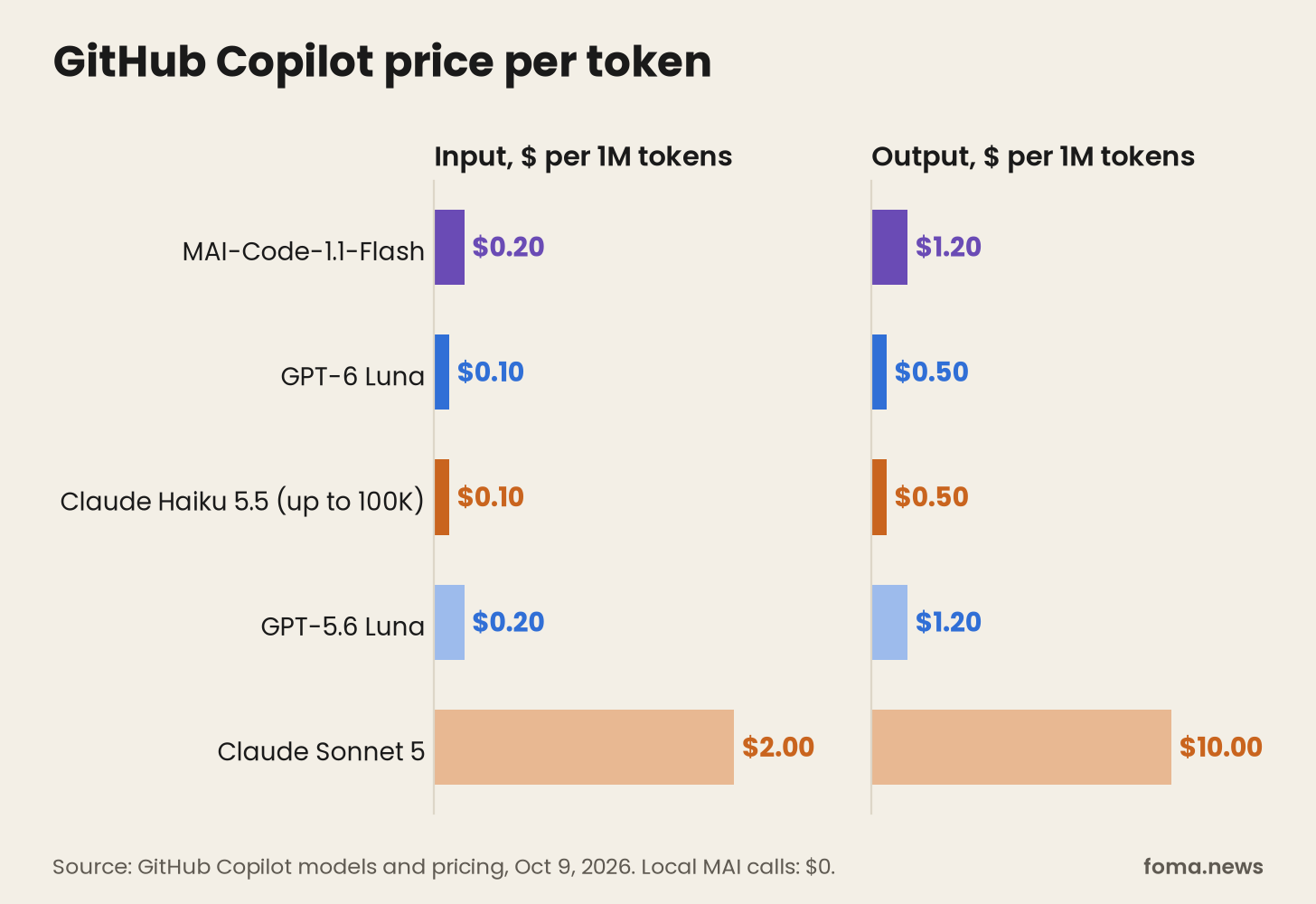
In the cloud, it's not the cheap option. In Copilot it costs $0.20 input and $1.20 output per million tokens, twice GPT-6 Luna and Claude Haiku 5.5 (under 100K tokens). Sonnet 5 is 10x on input.
Benchmarks: 72.6% on SWE-Bench Verified and 62.9% on Terminal-Bench 2.1 in Microsoft's Copilot harness, ahead of Haiku 4.5 and GPT-5.4 mini. Microsoft published no head-to-head with Luna, Haiku 5.5 or Sonnet 5.
Local Copilot access (app, CLI and VS Code) is promised as experimental "by end of the month."
Microsoft introduced the first MAI-Code-1-Flash at Build in June, the week FOMA covered Microsoft building a whole lab in public. Version 1.1 is the follow-up, and the interesting part isn't the cloud model. It's that Copilot can now send some of your coding to your own laptop.
What shipped on October 7?
Two things, per Microsoft's announcement.
A cheaper, leaner cloud model. Microsoft says 1.1 writes better code than the June model at a quarter of the price, uses 25% fewer tokens per task, and streams tokens 25% faster in Copilot. It focused on the command line and .NET: +22% on Terminal-Bench 2.1 in Copilot CLI and +15% on .NET tasks. In production, it says code survival rose 4% and return visits 9%.1
A local version. A quantized build squeezes the model to 53GB, an 80% cut, while keeping the full 256K context window. Microsoft recommends more than 120GB of RAM. Its reference machine is the Surface Laptop Ultra with NVIDIA RTX Spark and up to 128GB of unified memory, where peak memory hit 75.5GB at full context (GitHub and Windows post).2
One date to keep straight: Microsoft's model card lists August 11, 2026 as the release date, so the October 7 post is the price and on-device news, not the model's first day.3
MAI-Code-1.1-Flash benchmarks
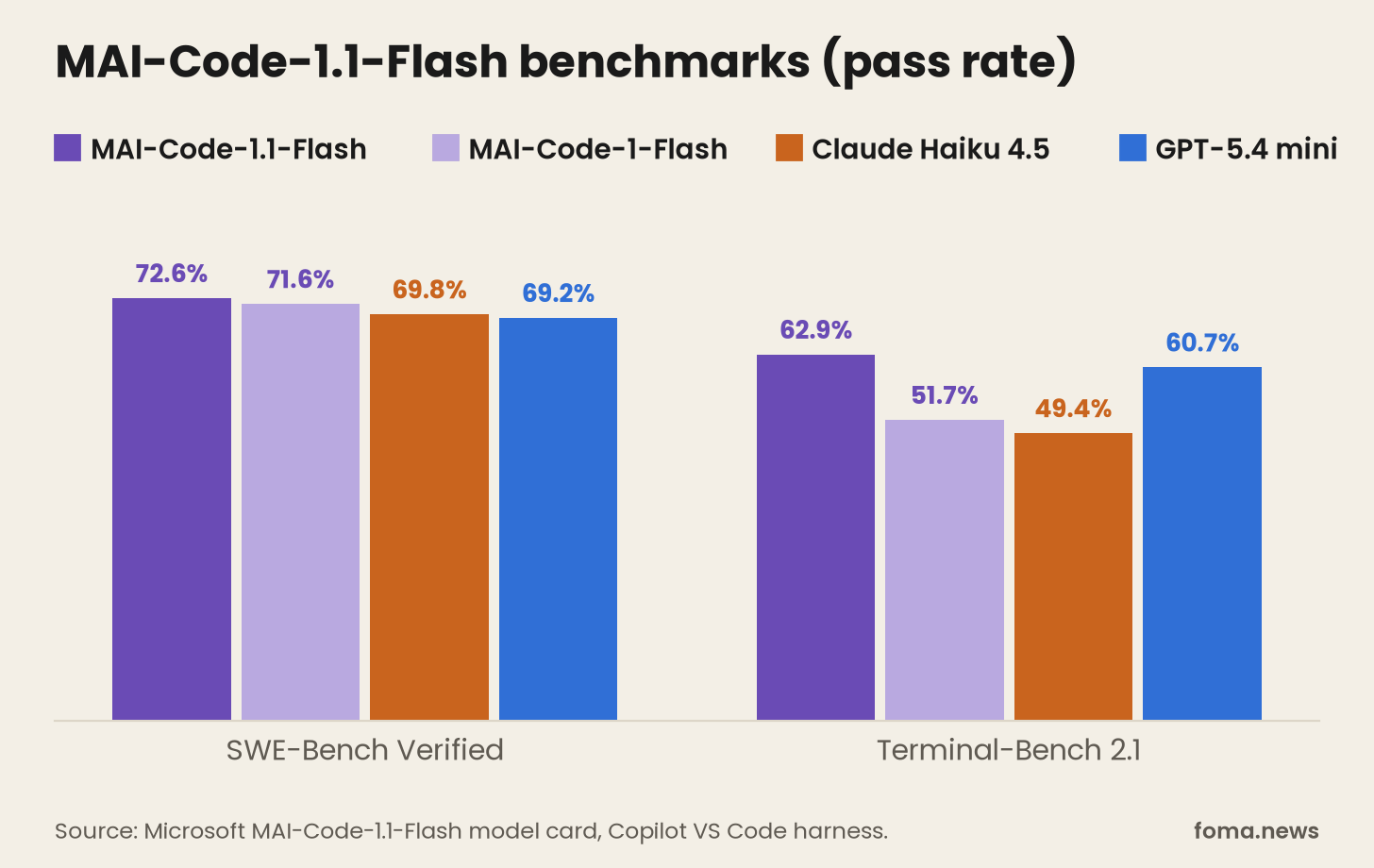
The model card compares 1.1 with its predecessor and two older small models, all run in the same VS Code harness Microsoft uses for Copilot:
SWE-Bench Verified: 72.6% for MAI-Code-1.1-Flash, 71.6% for MAI-Code-1-Flash, 69.8% for Claude Haiku 4.5, 69.2% for GPT-5.4 mini.
Terminal-Bench 2.1: 62.9%, 51.7%, 49.4% and 60.7%.
The token counts matter as much as the scores. On SWE-Bench Verified, 1.1 used 8.6K tokens per task against 20.9K for Haiku 4.5. Fewer tokens means a smaller bill at the same per-token price.4 It also takes images: it beat both rivals on Microsoft's internal text-to-web-app and screenshot-to-web-app tests.5
Two cautions. These are Microsoft's numbers in Microsoft's harness, which is a home game. And the comparison set is old: Haiku 4.5 and GPT-5.4 mini, not the models you'd actually pick against it today.
Does the local version hold up?
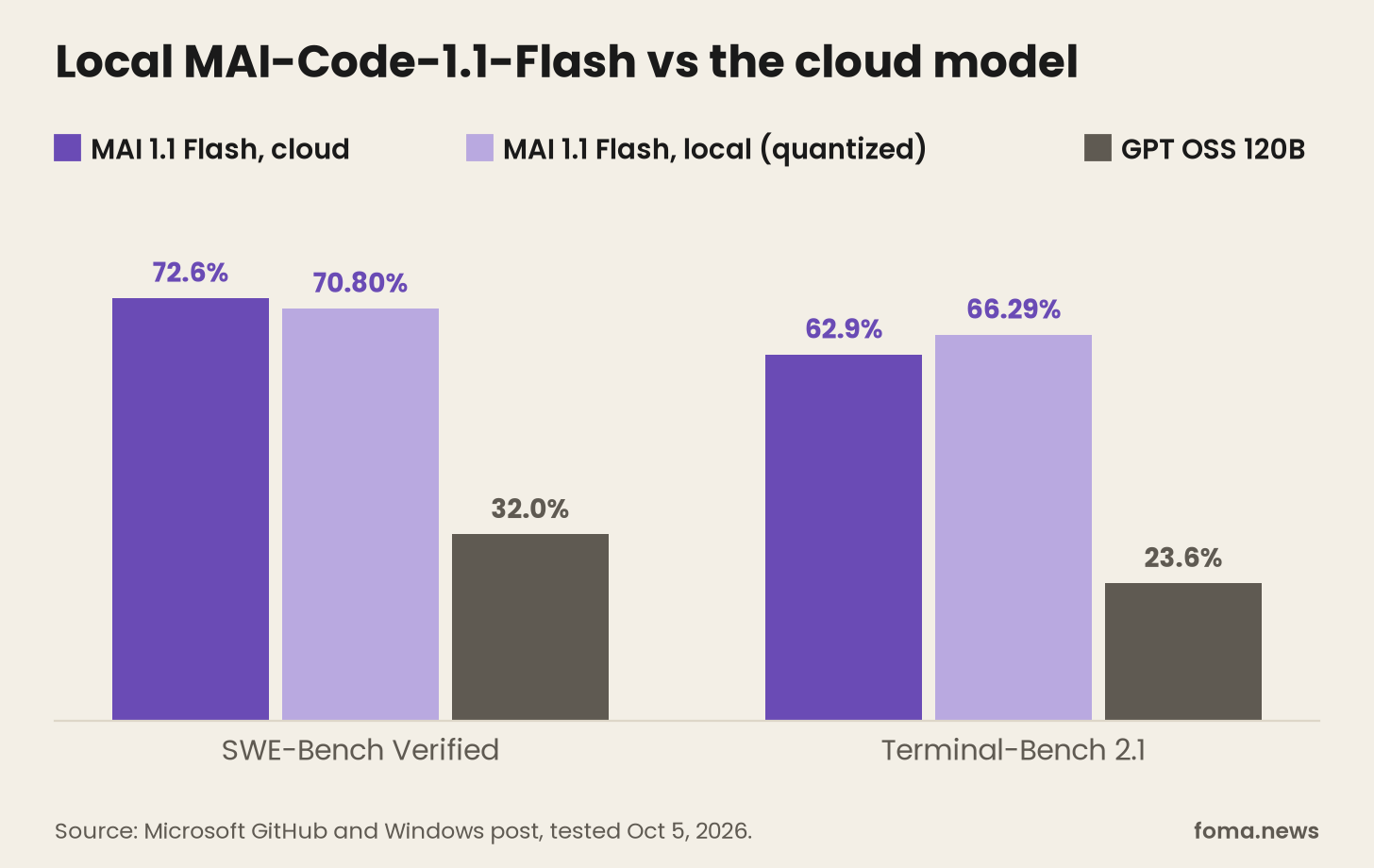
Mostly. In Microsoft's test on October 5, the quantized on-device build scored 70.80% on SWE-Bench Verified against 72.6% for the cloud model, and 66.29% on Terminal-Bench 2.1 against 62.9%. For scale, GPT OSS 120B scored 32.0% and 23.6%.6
MAI-Code-1.1-Flash pricing and availability
As of October 9, 2026:
GitHub Copilot (cloud): generally available, $0.20 input, $0.02 cached input and $1.20 output per million tokens, billed in AI credits at $0.01 per credit (GitHub's rate card).
Local: zero inference charges for local calls. Microsoft says the model is available to download now, with experimental access in the Copilot app, Copilot CLI and VS Code by the end of October.
Elsewhere: the model card lists pricing as "to be finalized" and describes it as available in GitHub Copilot. I found no public API price outside Copilot.
MAI-Code-1.1-Flash vs GPT-6 Luna
On price, Luna wins in the cloud: $0.10 input and $0.50 output in Copilot, half of MAI's input rate and well under half its output rate.7 MAI's price matches GPT-5.6 Luna exactly, a pairing people already search for. Its successor, GPT-6 Luna, launched on September 22 at half the price (FOMA covered that launch).
On quality, nobody has a fair answer yet. Microsoft didn't test GPT-6 Luna, and OpenAI didn't test MAI. If MAI really finishes tasks in fewer tokens, the per-task gap is smaller than the per-token one. Check your own Copilot usage before assuming either way.
MAI-Code-1.1-Flash vs Haiku
Against Haiku 4.5, MAI wins Microsoft's table on every coding score but one and uses fewer tokens. Against Claude Haiku 5.5, which Anthropic released on October 7, there's no shared benchmark. Haiku 5.5 costs half as much per token in Copilot up to 100K tokens, then 5x more above it.8
MAI-Code-1.1-Flash vs Sonnet 5
Different weight class. Claude Sonnet 5 costs $2 input and $10 output per million tokens in Copilot, 10x MAI on input. You pick Sonnet for the hard refactor and the bug nobody understands (FOMA on the Sonnet 5 launch). MAI is for the many small tasks around it.
How to try MAI-Code-1.1-Flash
Cloud: pick MAI-Code-1.1-Flash in the GitHub Copilot model picker. It bills at the rates above.
Local, explicit: select it through the Windows ML provider, or point Copilot at an OpenAI-compatible local endpoint.
Local, automatic: Copilot's Auto mode will route between local and cloud models. Microsoft says this lands by the end of the month.
Sandbox it: run /sandbox in Copilot CLI to limit what the agent's commands can touch. Local inference doesn't make the session offline.
Who is MAI-Code-1.1-Flash for?
Copilot users with a big-memory machine, first. Free local inference on a model that scored about 71% on SWE-Bench Verified is a real offer for routine edits, tests and scripts. Teams on .NET or heavy CLI work, second, since that's where Microsoft tuned it.
If you're paying per token in the cloud and don't need those strengths, GPT-6 Luna and Haiku 5.5 are cheaper per token today. Benchmarks against them would change this verdict; until then, it's Microsoft's word in Microsoft's harness.
So, MAI-Code-1.1-Flash or Luna?
You want to know whether Microsoft's coding model beats the cheap models you already use. In the cloud, not on price: GPT-6 Luna and Haiku 5.5 cost half as much per token, and nobody has tested them side by side. On your own 128GB machine, MAI is the better deal, because local calls are free and the quantized model keeps most of its scores. Use MAI locally for routine coding, Luna or Haiku 5.5 for cheap cloud calls, and Sonnet 5 when the task is hard.
Notes
All improvement figures compare 1.1 with MAI-Code-1-Flash and come from Microsoft's October 7 post. Microsoft says it trained across "more than hundreds of thousands" of reinforcement-learning environments in GitHub Copilot.
The local build uses mixed-precision quantization at about 3.3 bits per weight; Microsoft's announcement calls it 3-bit. Prompt processing reached 923.5 tokens per second at 64K context and 769.8 at 128K (GitHub and Windows post).
The model card also lists training from March to August 2026, text and image input, and a 256K context. The local-model post describes the local version as 137B total and 6.8B active parameters, which differs from the card's 138B and 5B; Microsoft hasn't explained the gap. The first version, MAI-Code-1-Flash, was introduced on June 2, 2026.
Average tokens per task, SWE-Bench Verified: 8.6K (1.1), 10.8K (1.0), 20.9K (Haiku 4.5), 9.4K (GPT-5.4 mini). Terminal-Bench 2.1: 17.0K, 14.2K, 25.5K, 21.9K (model card).
Text2WebApp: 74.1% vs 11.5% (Haiku 4.5) and 58.3% (GPT-5.4 mini). ScreenShot2WebApp: 42.1% vs 10.0% and 39.3%. On Vision2Web Level 3, Haiku 4.5 led with 13.7% against 11.5% and 10.1% (model card).
Microsoft's GPT OSS 120B comparison used Unsloth's GGUF build. Dataset sizes: 500 tasks for SWE-Bench Verified, 89 for Terminal-Bench 2.1 (GitHub and Windows post).
GPT-6 Luna in Copilot: $0.10 input, $0.01 cached, $0.50 output per million tokens up to 272K, the same as OpenAI's API price. GPT-5.6 Luna in Copilot: $0.20, $0.02 and $1.20 up to 200K (GitHub's rate card).
Claude Haiku 5.5 in Copilot: $0.10 input and $0.50 output up to 100K tokens, $0.50 and $2.50 above. Claude Haiku 4.5: $1 and $5 (GitHub's rate card).