

Last updated: October 11, 2026
A personal AI agent is an assistant that works for you across days, not just one chat: it has a computer or browser of its own, keeps going after you close the app, and asks before it spends money or sends anything.
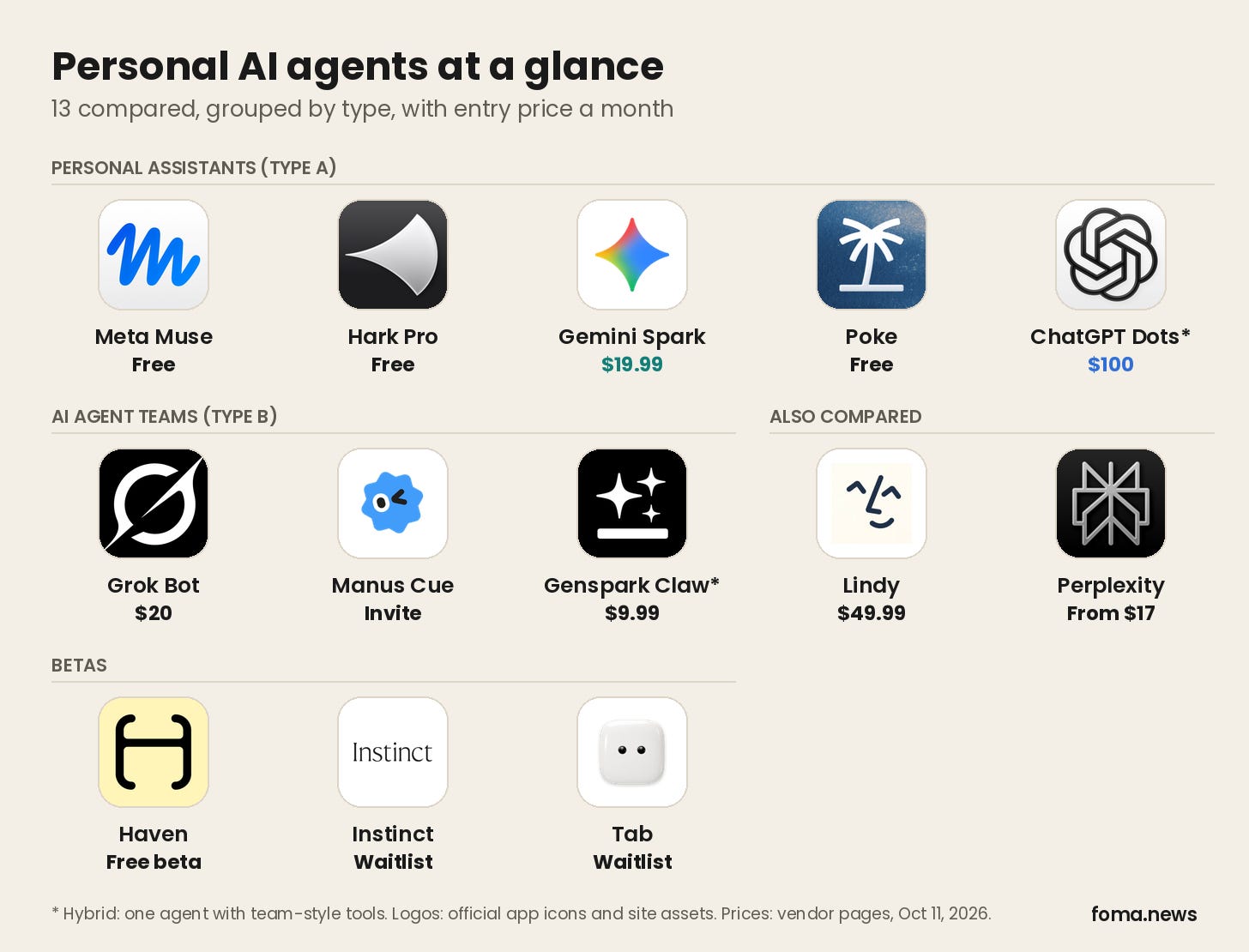
We compared 13, split by one question: do you want one agent or a team? Four left the chat box in one week (FOMA, October 1).
TL;DR
For errands (email, calendar, shopping): Muse is the best free personal AI agent and tops Assistant Benchmark at 9.3, but only in the US and Canada. Elsewhere, start with Gemini Spark if you pay for Google AI Pro ($19.99).
For projects that need a team of agents: Grok Bot is the only AI agent team on general release, from $20 a month on Cursor Pro. One tester says plan on a $100 tier.
Is ChatGPT Dots worth it? Only if you already pay for ChatGPT Pro ($100 and up). It is one agent, and Pro doesn't offer it in the EEA, UK or Switzerland.
Manus Cue is the closest Grok Bot rival, but invite-only.
One agent or a team?
Type A, personal assistant: one agent for errands (email, calendar, reminders, shopping, bookings) in WhatsApp, iMessage or an app.
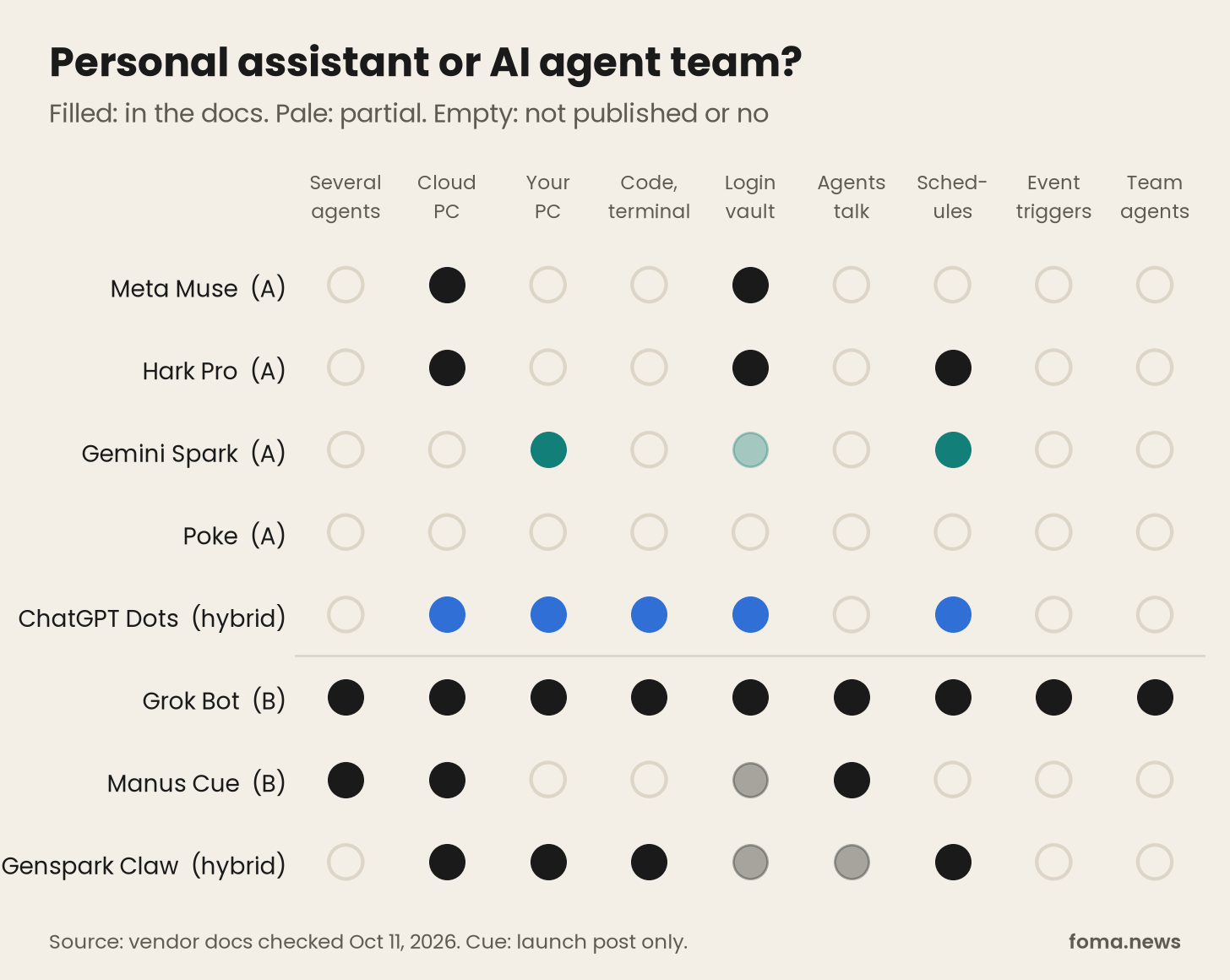
Type B, AI agent team: a multi-agent team is several agents, or teammates, that share a computer (browser and terminal), code and git, and stored logins they use without seeing passwords; they run on schedules or event triggers and message each other to hand off work. Below: agent teams, also called agent swarms or an AI workforce. Cue says "personal agents" but gives you several.
Hybrids have one agent with team-style tools (a cloud computer, terminal or coding hand-offs): Dots and Genspark Claw.
How we ranked them
Independent tests means a reviewer with no product in the race ran it: Assistant Benchmark (15 personal tasks) or Pat Simmons at AI for Mortals (three identical jobs, October 6). Vendor claims only means the maker's docs, checked October 11; "not published" means they are silent.1
Disclosure: FOMA's research is assisted by Grok Bot, one of the products ranked here. Its entry uses only Cursor's docs and independent tests.
Best personal assistants (type A), ranked
1. Meta Muse

Type A. Meta's agent, in its app or WhatsApp.
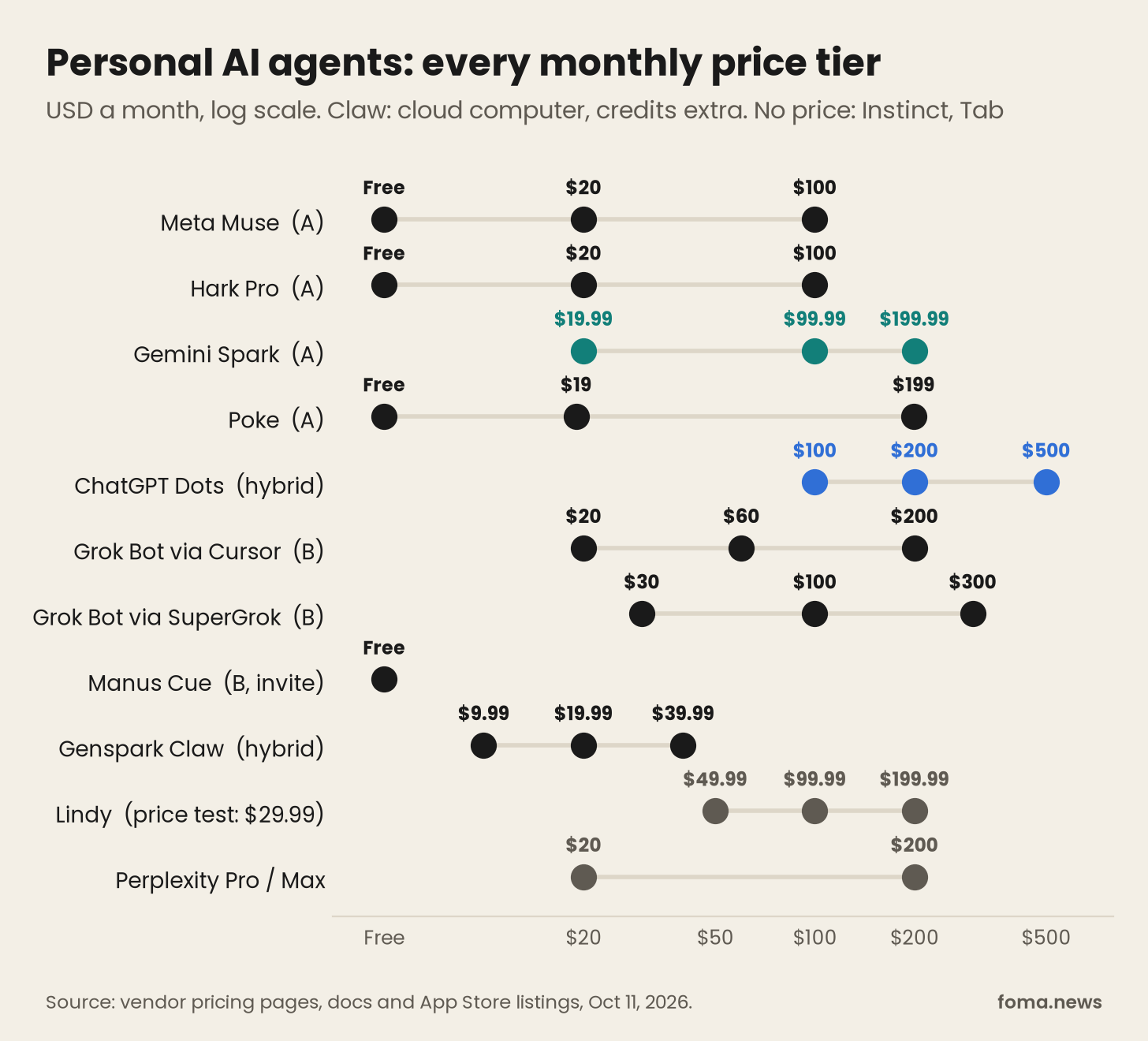
Price: Free; Power $20 a month; Maximum $100. Paid tiers buy bigger weekly allowances; run-out behaviour: not published.2
What you get: One agent on its own cloud computer; a separate Sentinel agent gates internet access. Uses stored logins unseen; one-time Stripe Link cards. Team agents, agent-to-agent and schedules: not published.
Availability: US and Canada, in limited testing.3
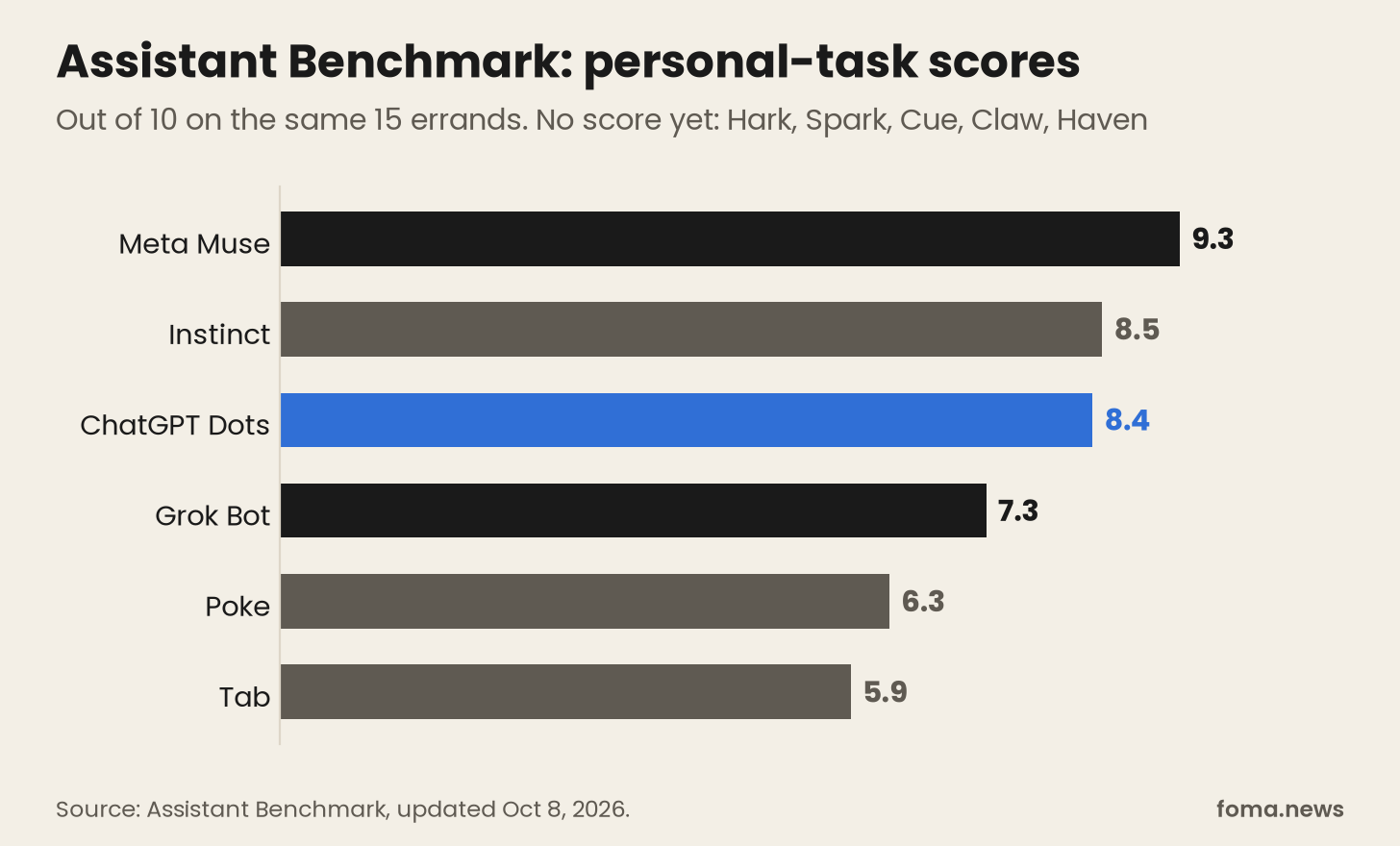
Evidence: Independent tests. First on Assistant Benchmark at 9.3, best at purchasing and email, but a D on AI for Mortals' coffee-shop job.4
2. Hark Pro

Type A. One persistent chat, on web, iOS and Android since October 6 (Hark).
Price: Free (the Hark Pro plan); Pro² $20 a month for 2x usage; Pro³ $100 for 10x. Same features on every plan.5
What you get: One agent by design ("no juggling agents"). Handoff cloud computer, encrypted vault for cards and logins, scheduled tasks, repeatable workflows, Google Workspace and Microsoft 365. Code and multi-agent: not published.
Availability: Region limits not published.
Evidence: Vendor claims only.6
3. Gemini Spark

Type A. Google's agent in the Gemini app (Google help).
Price: Included in Google AI Pro ($19.99 a month, ₪74.90 in Israel) and Ultra (from $99.99). Run-out behaviour: not published.7
What you get: One agent with schedules and Workspace actions. No computer of its own: it drives your Chrome or a remote browser that stops at sign-ins. Can use Google Password Manager logins.
Availability: Gemini countries except the EEA, UK, Switzerland and Nigeria; Israel is in.
Evidence: Vendor claims only. See FOMA's Spark launch coverage.
4. Poke

Type A. A text-message assistant in iMessage, Telegram, WhatsApp and RCS (Poke docs).
Price: Free, Pro $19 and Ultra $199 a month; yearly costs less.8
What you get: One agent for email, calendar, reminders, web search and integrations. Computer, vault and multi-agent: not published.
Availability: Worldwide.
Evidence: Independent tests. 6.3 on Assistant Benchmark, best at personality.
5. ChatGPT Dots (hybrid)

Hybrid. OpenAI's always-on agent (OpenAI docs).
Price: ChatGPT Pro at $100, $200 or $500 a month, or a Business Premium seat; higher tiers only add usage.9
What you get: One dot for now. Its own cloud computer plus one of yours; hands coding to Codex, which can push to GitHub; saves sign-ins to Passwords; schedules; Slack, Teams and calls.
Availability: Pro excludes the EEA, UK and Switzerland; Enterprise is admin-enabled.
Evidence: Independent tests. 8.4 on Assistant Benchmark; B on AI for Mortals' coffee-shop job.10
Betas: Haven, Instinct, Tab

Haven is a free memory-first assistant on calls, text and email; no paid tiers published.11

Instinct is an agent you text or call that "can use a phone and computer"; waitlist, price not published, 8.5 on Assistant Benchmark.12

Tab has its own number, computer and wallet over iMessage and WhatsApp; waitlist, price not published, 5.9.
Best AI agent teams (type B), ranked
1. Grok Bot

Type B. xAI's bots, sold through Cursor and SuperGrok (Cursor docs, FOMA). See the disclosure above.
Price: Cursor Pro $20, Pro+ $60, Ultra $200 or Teams from $40 a seat; SuperGrok $30, Plus $100 and Heavy $300 (X Premium+ included) match Pro, Pro+ and Ultra. Plans don't stack; weekly usage, then optional on-demand billing. SuperGrok Lite excludes it.13
What you get: Unlimited bots (teammates) sharing one persistent cloud computer (browser, files, terminal), or running on your own machine. Bots message each other and hand off work; group chats hold 2 to 6 bots. Routines run on schedules or events (Slack, GitHub, Linear, email, webhooks and more). Masked secrets it fills but never reads; Team Bots. 1Password and an explicit git workflow: not published.14
Availability: General release; region limits not published.
Evidence: Independent tests. Won all three AI for Mortals jobs, but 7.3 on Assistant Benchmark, which grades personal errands.15
2. Manus Cue (invite-only)

Type B. Manus's app for personal agents.
Price: Free in early access with an invite code; a US phone number costs extra ($9.99 in its iOS app).16
What you get: Several teammates, each with its own email, phone number, wallet and computer. In a group chat with a shared goal, "they hand work to each other". Code, vault and event triggers: not published.
Availability: Early access on web, desktop, Android and iOS.
Evidence: Vendor claims only.
3. Genspark Claw (hybrid)

Hybrid. One agent on a dedicated cloud computer, or local on your Mac or PC (Genspark help).
Price: Cloud Computer Lite $9.99, Standard $19.99 or Powerful $39.99 a month, plus Genspark credits; local mode skips the subscription. Out of credits: top up or upgrade.17
What you get: Terminal, files, GitHub, schedules and a Heartbeat check; logins saved in its browser; sub-agents; joins WhatsApp, Slack or Teams groups. One per person: "Claw is never shared".
Availability: Region limits not published.
Evidence: Vendor claims only.
Also compared, and what's out of scope

Lindy is a work assistant: one per person plus a shared Slack "Teammate", trigger-based routines and browser computer use from Pro. It costs from $49.99 per user a month (a $29.99 Plus also appears, likely a price test) to $199.99 for Max, after a 7-day trial with $50 in credits.18

Perplexity Personal Computer runs its Computer agent on your own Mac or PC with scheduled work, on Pro (from $17) or Max ($200, 10,000 credits a month).19
Out of scope: Claude Cowork (a hand-off tool) and Sesame (a voice companion).
Value verdict: which type is worth paying for?
Personal assistants: Muse is the value pick in the US or Canada: free, and top of the broadest independent test. Elsewhere, Spark is the cheapest add-on for Google AI Pro payers; Poke at $19 works anywhere. Hark is untested. Dots is overpriced for errands alone.
Agent teams: Grok Bot is the only one on general release and won AI for Mortals' tests; budget $60 to $100 a month for daily use. Cue may compete once it opens. Claw suits you if one agent with a terminal is enough.
So, which personal agent should you pay for?
If you pay for Google AI Pro, try Spark first. If you pay for ChatGPT Pro, your dot is included, so use it. If you pay for Cursor, SuperGrok or X Premium+, Grok Bot is already in your plan, and it is the pick for projects that need a team of agents. For errands, start on Muse's free tier in the US or Canada, or Spark or Poke elsewhere. Pay for a $100 tier only when limits block real work.
Notes
Assistant Benchmark had tested 32 of 139 assistants on the same 15 tasks, scored 1 to 10, updated October 8, 2026 (Assistant Benchmark). AI for Mortals had Opus 5.5 grade each agent against an answer key (AI for Mortals). We found no published score from either for Hark Pro, Gemini Spark, Manus Cue, Genspark Claw or Haven.
Muse: 8 of 15 tasks tested, 7-second median reply, 10 out of 10 on purchasing, email and routines (Assistant Benchmark). On AI for Mortals' four-hour coffee-company job, the grades were Grok Bot A-, Dots B, Muse D (AI for Mortals).
"All features are offered in all plans. Upgrading your plan increases usage" (Hark pricing); auto top-up when you run out, per Using Hark. The same free, $20 and $100 ladder was reported at launch (Gizmodo).
Hark's CEO is Brett Adcock. TNW reports it can drive up to 36 browsers at once (TNW); TechCrunch says its model is trained for computer use (TechCrunch).
Spark requires age 18+, a personal (not work or school) Google Account, Keep Activity on, and the Gemini mobile, Mac or web app (Google). Plan prices from Google One and Gemini plans: Pro is $199.99 a year; Ultra is monthly only, $99.99 for 5x Pro's usage or $199.99 for 20x. Israeli prices from Gemini Israel.
Prices from Poke pricing (poke.com); Poke says it is available in all regions (Poke docs). Yearly billing works out to $16 (Pro) and $160 (Ultra) a month; Ultra adds pay-as-you-go. Background: TechCrunch.
Chatting with a dot doesn't use ChatGPT limits; Work and Codex tasks do. Plans and regions from OpenAI help and OpenAI docs; Pro tiers, billed monthly only, from Pro tiers; Business Premium, $125 a seat or $100 billed annually with a 2-seat minimum, from OpenAI. OpenAI says dots plug into 4,000+ apps (OpenAI). Texting a dot is a limited US beta.
Dots: 26-second median reply on Assistant Benchmark. AI for Mortals: "You need ChatGPT Pro, which starts at $100 a month. The $200 and $500 plans only add usage."
Haven launched September 17, 2026, founded by Frank Addante and Duc Chau, with a $15M Mayfield-led pre-seed (PR Newswire).
Instinct reportedly raised a $1B Series C at a $10B valuation (TechCrunch); its early terms drew privacy criticism (TechCrunch).
Cursor prices from cursor.com/pricing and team pricing (Teams $40 a seat, $120 for a 5x Premium seat). SuperGrok Lite $10, SuperGrok $30, SuperGrok Plus $100 and SuperGrok Heavy $300 a month from grok.com/plans (Individual tab); Heavy includes X Premium+ at no extra cost. Cursor says Pro, SuperGrok and X Premium+ are the same tier, Pro+ equals SuperGrok Plus, and Ultra equals SuperGrok Heavy (Cursor plans). X Premium+ is $40 a month or $395 a year on the web in the US (X help).
xAI's launch post pitches bots you message like coworkers. Sources: routines, secrets, group chats, Team Bots (cloud only), agent email. The security docs use running git status as an approval-rule example.
AI for Mortals: Grok Bot was fastest on the Montreal trip and about $90 cheaper than Muse on flights and $136 on the Airbnb. Simmons used 83% of his plan on small tests, hit the limit mid second job, paid $30 more on-demand, and says "plan on a $100 tier." Assistant Benchmark's reviewer calls Grok Bot "a worker" whose purchases end at a login wall (Assistant Benchmark).
Manus offered the limited invite code MEETCUE; phone numbers are billed apart from Manus memberships (Manus help), and the App Store listing gives no billing period. Its Cascade harness used 23.2% fewer tokens and cost 32% less than the prior system in one Manus test (Manus). Phone-number pitch at cue.im.
Prices from genspark.ai/claw, where Genspark's help center points. Yearly prices: $104.99, $209.99 or $419.99, with 2,000 to 10,000 bonus credits. Older third-party figures of $39.99 and $79.99 are out of date. Credits come with Plus ($24.99) or Pro ($249.99) (Genspark plans). Team plans buy separate Claws (Genspark).
Pro is $99.99. On October 11 the pricing page showed a credit slider from $49.99 (5,000 credits) up to $9,999.50, while its page data listed Plus $29.99 (3,000 credits), Pro $99.99 (15,000) and Max $199.99 (35,000). Computer use is on Pro and Max; extra credits cost $10 per 1,000, and Lindy pauses when the pool runs out (Lindy pricing, docs, routines).
Pro is $17 a month billed annually on Perplexity's site ($20 month-to-month in its App Store listing), with Expanded Computer access: weekly usage but no monthly credits (credits). Max is $200 a month or $2,000 a year (annual billing on the web only; Perplexity Max); the site shows $167 a month billed annually, with Maximum Computer usage and 10,000 monthly credits. Limited-time site offers add $40 (Pro, 4,000 bonus credits) or $450 (Max) in Computer credits. Personal Computer is Perplexity's app that runs Computer on your own machine; its local models run on Pro, Max and Enterprise and use no credits (help page, updated Sep 29). Cowork runs in the cloud by default since October 6 (Claude help); Sesame is on iOS and Android.