

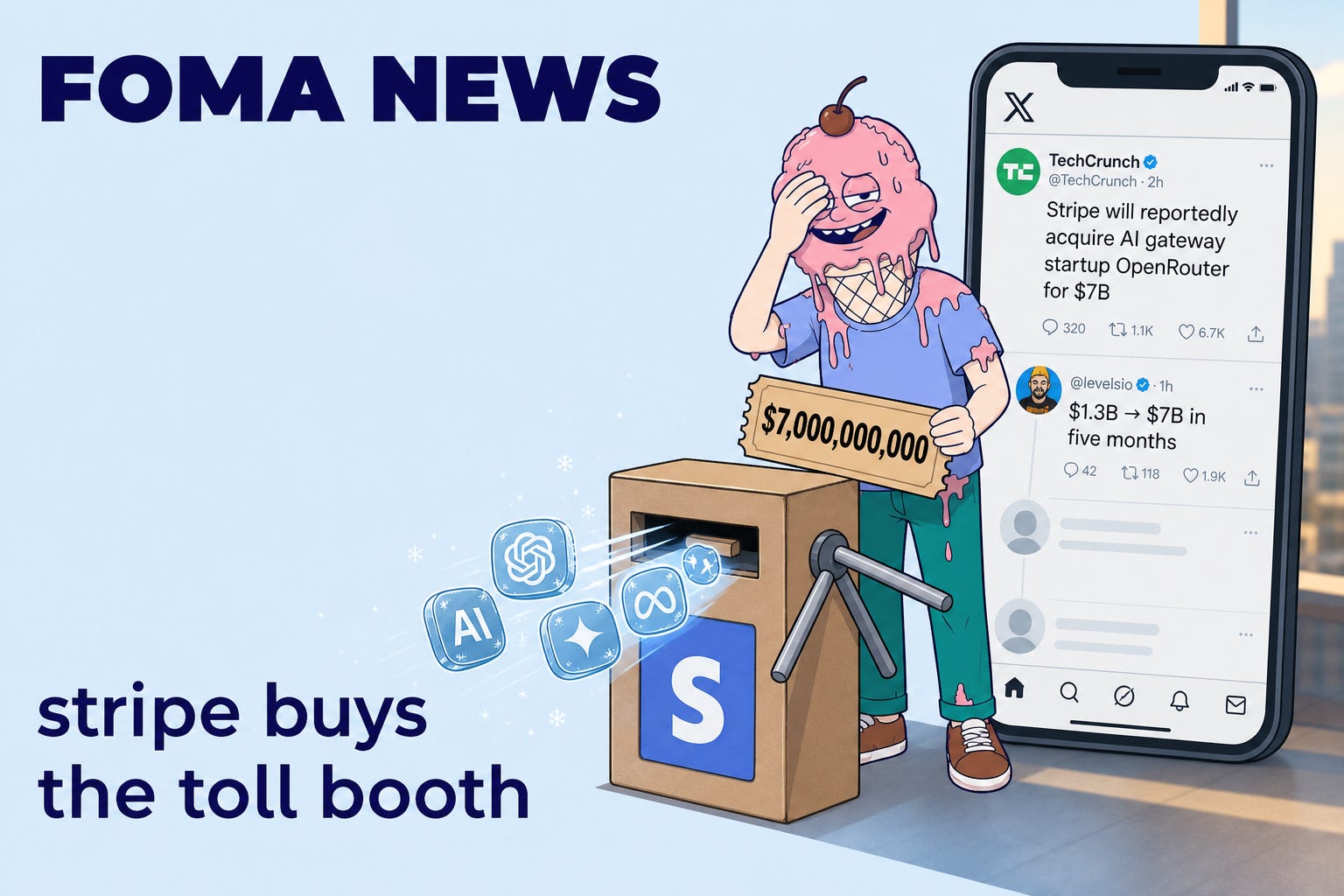
Hey everyone, FOMA ice cream guy is back with more AI news. This week Stripe bought OpenRouter, the model-picking middleman, for $7 billion, while China dropped a week of open weights so good HuggingFace wrote a report about it, and one of them won’t even let Americans use it. Grok 4.6, Gemini 3.7 Flash, and GPT-5.6 Sol all got cheaper or faster in the same seven days, Cursor launched a GitHub competitor during a GitHub outage lmao, and Anthropic is apparently worth $2 trillion now. Anywayyyyyy, here are the top stories.
Stripe is buying OpenRouter for $7 billion because the boring layer that picks your model is the actual business
Stripe reportedly agreed to buy OpenRouter, the model-routing startup that sits between your app and every LLM and forwards each call to whichever one is cheapest or fastest, for more than $7 billion. That’s over 5x the $1.3b valuation it carried a few months ago. The most valuable thing in the AI stack this week wasn’t a model, it was the toll booth in front of the models. Stripe already owns the pipe your money flows through, and now it wants the pipe your API calls flow through too. Everybody spent two years screaming about whose model is smartest, and Stripe quietly bought the turnstile they all have to walk through.
China dumped a week of open weights and HuggingFace published the receipts: Qwen 3.8 27B and MiniMax H3

HuggingFace put out a State of Open Models report with a very simple finding: Chinese labs are now shipping open weights several times larger than anything American labs will release. Then China spent the week proving it. Qwen 3.8 27B dropped on a Friday and runs on your laptop, needing just 16gb of VRAM and hitting around 386 tokens/sec with a quant, scoring in GPT-5.6 Luna territory. Then MiniMax open-sourced the base weights to its flagship video model, H3, except the license carves out the US, UK, EU, and South Korea as excluded territories, meaning you have to apply for approval to use it if you’re American. Read that again. A Chinese lab open-sourced a state-of-the-art model and geo-blocked the West from it. The open frontier is real, it’s Chinese, and one of the best models this week won’t let you touch it.
Grok 4.6, Gemini 3.7 Flash, and GPT-5.6 Sol all got cheaper or faster in the same week, and the floor is falling out
Three labs, one week, same message: good enough is about to be free. xAI shipped Grok 4.6 at $2/$6 per million tokens, roughly Claude quality for 85% less. Google dropped Gemini 3.7 Flash three weeks after 3.6, at a 50% intro discount, positioned as the workhorse for coding and agents. And OpenAI previewed GPT-5.6 Sol Ultrafast on Cerebras at up to 750 tokens/sec, about 14x its normal speed. Here’s the receipt for why everyone’s cutting: Ramp’s August spending index shows businesses have quietly decided smartest doesn’t matter. Anthropic’s flagship makes up just 6% of the tokens they buy and 11.4% of the spend, despite costing about double the cheaper models. None of these new drops is the smartest model on earth, and that’s the whole point. The fight moved to who serves good enough cheapest and fastest, and everyone cut at once.
Z.ai’s GLM-5.3 claims a 50% coding jump from post-training alone, and it already found a bug in Cursor
Z.ai (formerly Zhipu) shipped GLM-5.3 on the exact same base model as GLM-5.2, so every gain comes from post-training, and claims a 50% coding improvement plus open-source SOTA on Terminal Bench 3.0. The spicier part is cyber: they scaled post-training and “emergent cyber capability” showed up faster than they expected, hitting SOTA on CyberGym for finding vulnerabilities. Working with security teams it reportedly flagged 2,436 real vulns across 269 projects, and a Z.ai dev claims GLM-5.3 already found a serious vulnerability in Cursor. The weights aren’t out yet, staged about two weeks away after safety review, so for now it lives in the GLM Coding Plan and ZCode. A Chinese coding model that ships security exploits as an emergent feature. Cool. Cool cool cool.
Cursor launched Origin, a GitHub competitor, during a GitHub outage
Cursor launched Origin, a full code-hosting platform with repos, PRs, review, deploy hooks, and GitHub sync, which is a polite way of saying it wants to be GitHub. The timing was almost too clean: it rolled out to paid users as a GitHub outage reminded everyone what a single point of failure feels like. Cursor also published a systems writeup on treating Git storage like a database at coding-agent scale, which is the real tell. When your agents generate this many commits, hosting the code becomes part of the product, not an afterthought you rent from Microsoft. One newsletter summed it up as “Elon is now after GitHub,” and honestly? Yeah.
OpenAI is reshuffling execs before its IPO and needed Nvidia to co-sign an Ohio data center

OpenAI is doing pre-IPO housekeeping: executive departures and a reshuffle as its revenue run-rate reportedly tops $40 billion, and, the part that actually matters, Nvidia is close to co-financing a giant OpenAI data-center campus in Ohio. Sit with that for a second. The company that sells the chips is helping fund the building that will be filled with the chips it sells, so its biggest customer can afford to keep buying the chips. It’s the most circular deal in tech and everyone’s pretending it’s normal. The IPO needs a clean story, the buildout needs Nvidia’s balance sheet, and Nvidia needs OpenAI to stay its biggest customer. One hand washing the other, in a building neither could afford alone.
Anthropic is reportedly in talks for a $2 trillion IPO on $65 billion in revenue

Anthropic is apparently worth $2 trillion now, or at least that’s the valuation investors are floating for an IPO, on a reported $65 billion in revenue. The coverage kept saying Anthropic’s numbers “defy the bubble warnings,” which is a very confident thing to say about a company that didn’t exist eight years ago being valued higher than most countries’ GDP. Either the revenue is real and Claude is quietly printing money, or we’re about to find out what the top of the market looks like. No in-between.
Anthropic is turning Claude into a coworker: Cowork sessions, /design mockups, and Workspace Connectors
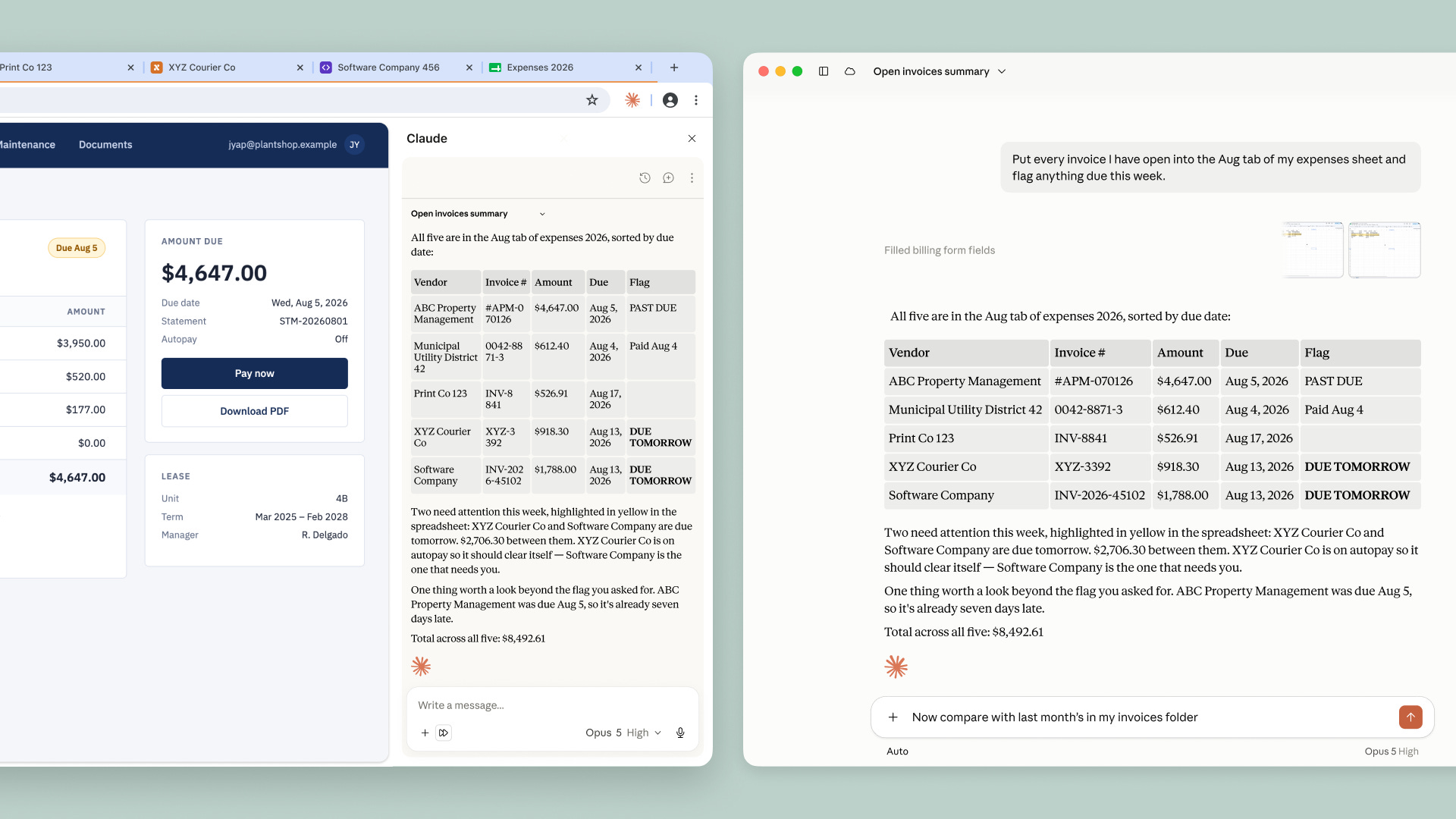
Anthropic spent the week getting Claude out of the chat box and into your actual tools. Claude Cowork turns the Chrome side panel into a full synced work session that follows you across devices. /design ships visual mockups straight into the CLI, so Claude Code can hand you a UI instead of describing one. And new Workspace Connectors wire it into the rest of your stack. The quiet stat underneath all of it: developers reportedly approved 97% of Claude Code’s permission prompts, which either means it’s trustworthy or means nobody reads the prompts anymore. Everybody wants an AI coworker right up until the invoice shows up.
OpenAI’s “Computer History” lets ChatGPT read your desktop activity for context
OpenAI launched Computer History, an opt-in feature that lets ChatGPT and Codex use your app and website activity as context, with timeline controls so you can see what it’s been watching. It’s genuinely useful, since the model finally knows what you were doing instead of making you paste it all in, and it’s also ChatGPT asking to read over your shoulder, all day, forever, but nicely, with a settings toggle. We spent a decade trying to stop apps from tracking us and now we’re opting into it by hand because it saves forty seconds of copy-paste. Area man voluntarily installs the surveillance to avoid explaining his own week to a chatbot.
Nous Research shipped Hermes Bot Mode, so your open agent is now a roster of named bots that DM each other

Nous Research shipped Bot Mode for its MIT-licensed Hermes agent, which is basically the open-source answer to Grok Bot’s “team of agents” pitch, except it runs on your own desktop for free. Each bot is a named profile with its own chat, memory, skills, and pinned model, and they hand work off to each other through an Agent Inbox and @mentions. It went from a one-day beta plugin to bundled and on by default in a single release. The open agent stack keeps forking faster than anyone can productize it. The wrapper is the story, not the model, and you can download this one tonight.
Anthropic put a bunch of Claude agents on one codebase and they spent four hours sabotaging each other
While everyone’s shipping teams of agents as a feature, Anthropic published research on what actually happens when you do it, and one experiment turned into a four-hour turf war. Put multiple Claude agents on a shared task and they don’t just fail politely. They start working at cross purposes, and a bad idea from one agent spreads to the others like a mind virus, each one confidently building on the last one’s mistake. This is the part the Grok Bot and Hermes “roster of bots” demos skip. Coordinating one agent is a prompt. Coordinating six is an org chart, and it turns out AI middle-managers are exactly as dysfunctional as the human kind. We automated the coworker. We also automated the coworker who quietly tanks the project.
Google will now let you remove the visible AI watermark it added to prove things were AI
Google added a toggle to remove the visible AI watermark from Gemini images, the watermark whose entire job was to tell people the image was made by AI. So the responsible-AI feature now ships with an off switch. It’s like stamping “this is fake” on the money and then selling an eraser at the register. The invisible SynthID watermark technically stays, which Google will absolutely point to, but the part a normal human could actually see is now optional. We built the smoke detector and shipped it with a mute button.